Revenge Trading: The 22% Win Rate and the 30-Minute Fix
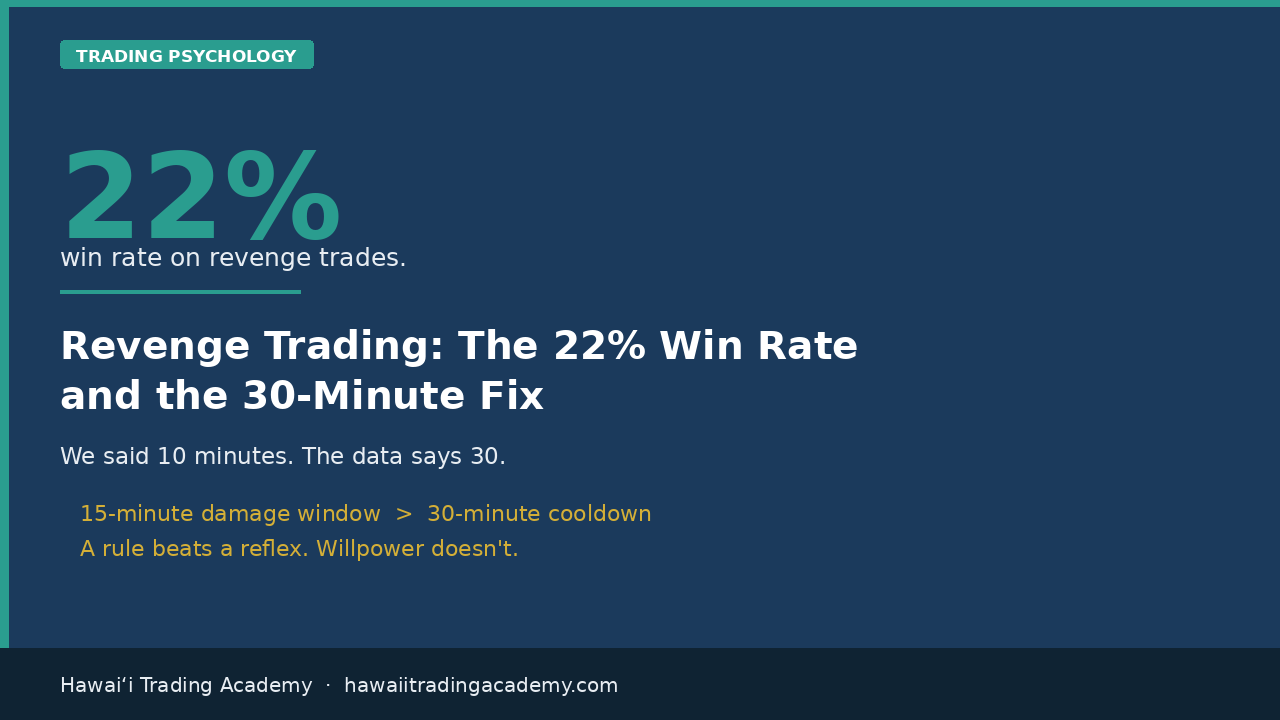
We told you to wait 10 minutes. The data says that is not long enough.
Earlier this month we published a piece on the drawdown reflex, the biological panic response behind roughly 74% of prop firm breaches. In it we gave you a rule: after any loss, wait 10 minutes before entering a new trade. Let the cortisol drop. Let your prefrontal cortex come back online.
That rule was directionally right. The number was wrong. Here is what the revenge trading data changed about our thinking.
What does the revenge trading data actually show?
Revenge trading has a measurable signature. In journal data it shows up as a specific, identifiable trade: an entry placed within 15 minutes of a loss, at larger than normal size.
Filter for those two conditions and the numbers are ugly. Those trades won 22% of the time.
Sit with that for a second. Your strategy might win 55%, 60%, 65%. Our RVOL + VWAP mean reversion setup wins 64% across 4,672 backtested trades. The same trader, on the same day, trading the same instrument, drops to 22% the moment the trade is a revenge trade.
Nothing about the market changed. The edge did not evaporate. The only variables are when the trade was placed and how big it was.
And notice what that 22% is actually doing. It is not just a bad win rate. It is a bad win rate at elevated size. You are betting more money on worse odds. That is the exact inversion of everything risk management asks of you, executed at the worst possible moment, by the person who knows better.
One trader's journal review put the cost at roughly $4,200 a month. A 30-minute cooldown rule removed the category entirely.
Why is a 10-minute rule not enough to stop revenge trading?
Here is the part that matters, and the reason we are correcting our own guidance.
Revenge trades were defined as entries within 15 minutes of a loss. That is the measured damage window.
A 10-minute cooldown expires inside that window. You wait your 10 minutes, you feel like you followed the rule, and then you place a trade at minute 11 that lands squarely in the middle of the behavior the rule existed to prevent. The rule gave you permission to do the exact thing it was written to stop.
That is worse than having no rule at all, because it comes with a clean conscience. You are not fighting the urge anymore. You have been pre-approved.
If the damage window is 15 minutes, your cooldown has to clear 15 minutes with room to spare. Thirty minutes clears it. There is nothing magic about the number. It is simply the first round figure that sits comfortably outside the zone where the data says traders hurt themselves.
Why can't you just be more disciplined?
You just learned the concept. Now find the weak link in your own process.
Free 3-minute Trader Process Assessment. Personalized score across Risk, Edge, Execution, and Review.
Because willpower is not the mechanism, and every trader who has tried to discipline their way out of revenge trading has learned that the expensive way.
We made this case in our post on the psychological operating system: willpower is a depleted resource. You wake up with a full tank. By the third day of a losing streak you are running on fumes. The reflex fires fastest exactly when your reserves are lowest. That is not bad luck. That is the design.
"I'll be more disciplined tomorrow" is not a plan. It is the same bet that already lost.
A cooldown works because it asks nothing of you in the moment. It is not a judgment call you make while your amygdala is running the show. The decision was already made, while you were calm, before the session opened. All you have to do is obey a timer.
That is the whole point. A rule beats a reflex. Willpower does not.
How do you actually install the 30-minute rule?
The rule is simple. Installing it is where traders fail. Here is how we teach it in our Hawaii trading education programs:
Set an actual timer. Not a mental note. When you take a loss that stings, start a 30-minute timer on your phone. While it runs, you are not allowed to enter. No exceptions, no "this setup is different."
Leave the screen. The chart is the trigger. Sit there watching price move without you and you will talk yourself into an entry before the timer ends. Go outside. Get water. We are in Hawaiʻi, so go look at something that is not a candle.
Define what counts. A small scratch does not need a cooldown. A full stop-out that made you say something out loud does. Write your own trigger before you need it. Our post on the 5 emotional enemies every trader faces maps the frustration-to-revenge pipeline, and the throttle only works if you defined it in advance.
Log the urge, not just the trade. In TradeZella or a plain spreadsheet, record the trades you wanted to take during a cooldown and did not. After a month, price out what those would have cost you. That number is your rule's P&L, and it is usually the most persuasive figure in the whole journal. This is the same reason we argue your journal beats any indicator you will ever add.
Make it automatic. If your platform or prop firm supports session lockouts, use them. The best rule is the one you cannot negotiate with at 8:31am.
Does a cooldown cost you good trades?
Sometimes. Yes. We are not going to pretend otherwise.
Occasionally the setup at minute 12 is real, you will miss it, and you will be annoyed for the rest of the session.
But look at the trade you are making. You give up a small number of legitimate entries to delete an entire category of revenge trading that wins 22% at inflated size. Run that through any expectancy calculation and it is not close. A cooldown is a positive expectancy decision even though it feels like a cost every time you follow it.
That is true of most good risk rules. They feel like a tax in the moment and read like a bargain on the monthly statement.
The bottom line
Revenge trading is not a character flaw. It is a predictable, measurable behavior with a known signature: inside 15 minutes, oversized, 22% win rate, roughly $4,200 a month in one documented case.
Predictable behavior can be engineered around. That is the good news here. You do not have to become a different person or find more discipline than you have. You have to set a timer and walk away from the screen.
We said 10 minutes. The data says 30. Take the 30.
If you want the rest of the mental frameworks our trading coaches build with students before a single dollar of risk goes on, we put together a free guide covering the systems we teach at Hawaiʻi Trading Academy.
We also break down trading under pressure on the Edge Up Podcast on Spotify.
Trading futures involves substantial risk of loss and is not suitable for all investors.
You just learned the concept. Now find the weak link in your own process.
Free 3-minute Trader Process Assessment. Personalized score across Risk, Edge, Execution, and Review.
Mahalo for reading and trade well!
- Glenn & Reid | Hawaiʻi Trading Academy
For education only. Nothing here is financial advice or a recommendation to trade any instrument. Futures trading carries substantial risk of loss and is not suitable for every investor. Past performance does not guarantee future results.