Why Most Traders Lose Money (And What Actually Fixes It)
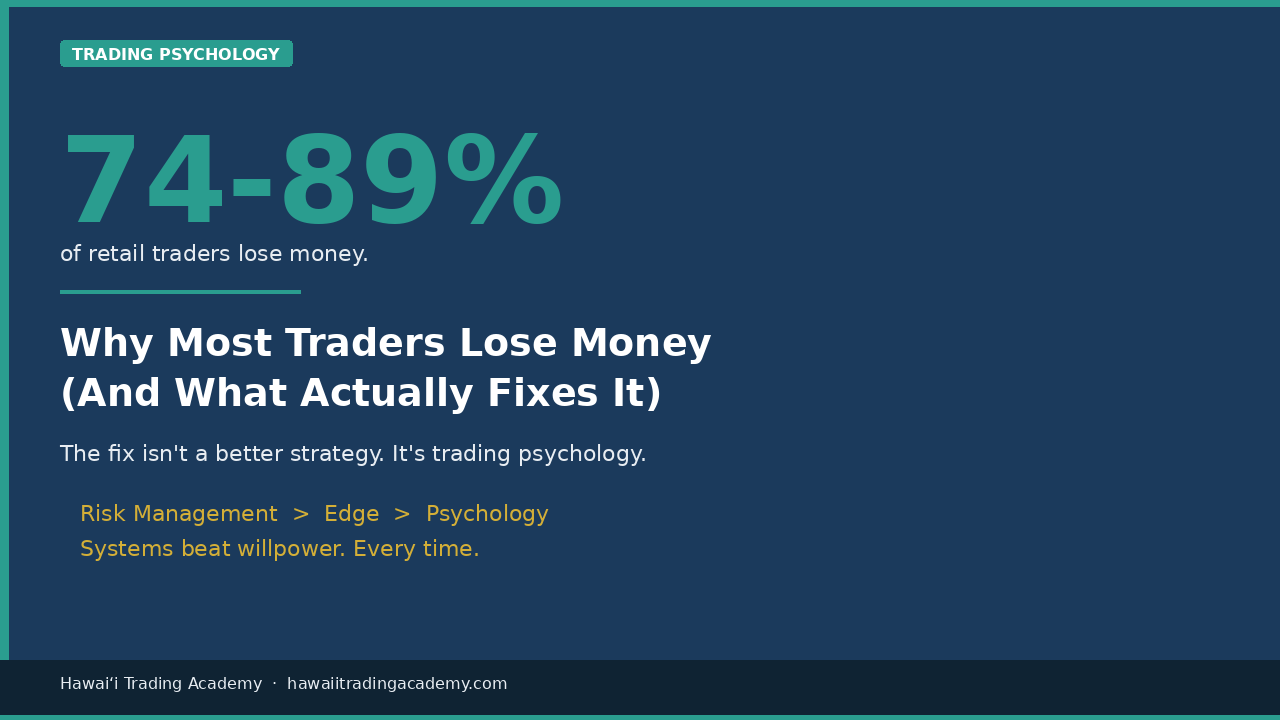
Here's a number that should make you uncomfortable: somewhere between 74% and 89% of retail traders lose money. That range comes from broker disclosures, FINRA reports, and academic studies spanning over a decade. The exact number depends on the asset class and time horizon, but the direction never changes.
Most traders already know this. They've read it in every "top 10 trading tips" article on the internet. And then they do the same thing everyone else does - they go looking for a better strategy.
That's the wrong move.
What Does the Data Actually Say?
A 2019 study out of Brazil tracked 19,646 day traders over two years. 97% of them lost money after 300 days. Not "didn't beat the market" - lost money. The ones who stuck around long enough to be profitable? They made an average of $310 per day. The median was closer to $54.
FINRA data shows 72% of day traders ended their most recent year with financial losses. And more than 75% quit within two years.
Those numbers look like a strategy problem. They're not. We've coached hundreds of traders through our Net Alpha program, and the pattern is always the same: the traders who fail usually have decent setups. What they don't have is the psychology to execute them.
Why Strategy Isn't the Problem
You can have a strategy with a 65% win rate backtested over 2,000+ trades - like our MID-range setup in TradeZella - and still blow your account. How? Position sizing. Revenge trading. Moving stops. Cutting winners early.
Loss aversion is baked into your biology. Research shows that losing $500 feels roughly twice as painful as winning $500 feels good. That asymmetry makes you do irrational things. You hold losers too long hoping they'll come back. You cut winners too short because you're afraid to give back gains. Traders sell winning positions at a 50% higher rate than losing ones.
This isn't a discipline problem you can fix with a motivational quote. It's a biological response - your amygdala firing survival signals that override rational thinking. We wrote about this in detail in our recent post on The Drawdown Reflex.
What Separates the 11% Who Make Money?
It's not a secret indicator. It's not a proprietary algorithm. It's three things, and they're all psychological:
They have rules and they follow them. Not "guidelines." Not "general approach." Written rules with specific conditions for entry, exit, and position size. When Reid (my co-founder) trades the NY session at 3:30 AM HST, he's not making decisions - he's executing a system. The decisions were made during backtesting, not during the trade.
They manage risk before they manage entries. Here's something we teach in every session: you could have a 70% win rate and still blow your account if you're risking 10% per trade. Four losers in a row puts you down 40%. At HTA, risk management is the R in our REPs framework - it comes first because everything else depends on it.
They journal and review. We use TradeZella for journaling and backtesting. Every trade gets logged. Every week gets reviewed. The traders who do this consistently improve. The ones who skip it keep making the same mistakes and blame the market.
How Do You Fix a Psychology Problem?
You don't fix it with willpower. You fix it with systems.
Pre-session rules that define your maximum loss before you sit down. Mechanical stop-losses that remove the decision from the moment. Forced cooldown periods after two consecutive losses. Position sizing formulas that cap your risk per trade at 1-2% of your account, no exceptions.
One of our students texted last month after his first green week in three months. The only thing that changed? He added a kill switch - if he hit -$300 for the day, he closed the platform. No negotiations. No "one more trade." His strategy was the same one he'd been using for six months. His psychology was the bottleneck, and the kill switch removed his ability to act on it.
We talk about this a lot on the Edge Up Podcast - the gap between knowing what to do and actually doing it under pressure. That gap is where 74-89% of traders fall.
The Framework That Changes Everything
At Hawai'i Trading Academy, we built our entire curriculum around three pillars: Risk management, Edge, and Psychology - REPs. Most trading education starts with edge (strategies, setups, indicators). We start with risk management because without it, nothing else matters. And we weave psychology into everything because it's the differentiator between the 74% who lose and the 11% who don't.
The stat everyone quotes is that "most traders lose money." The stat nobody talks about is that most traders never build a system to protect them from themselves.
Your strategy is probably fine. Your risk management might need work. Your psychology almost certainly does.
Stop looking for a better setup. Start building better systems.
Want to build these systems yourself? Download the HTA Psychology Guide — our framework for building rules that override biological trading mistakes before they cost you money.
Trading futures involves substantial risk of loss and is not suitable for all investors. Past performance is not indicative of future results.
Mahalo for reading and trade well!
- Glenn & Reid | Hawai'i Trading Academy