Why Traders Fail Prop Firm Evaluations (It Is Not Edge)
Ask a trader who just blew an evaluation what went wrong and you will almost always hear the same thing. "My strategy stopped working." Nine times out of ten, that is not what happened.
The strategy was fine. A risk rule caught them sizing too big, on the wrong day, at the wrong moment. The edge did not fail. The risk management did.
If you understand that distinction, you are already ahead of most people paying for funded accounts. Let's break down why traders actually fail prop firm evaluations, and how to size so the rules never catch you.
Is It Really Your Strategy That Failed?
Almost never. Think about what an evaluation measures. It does not grade the quality of your setups. It grades whether you can generate a target without tripping a loss limit. Those are two completely different tests, and most traders only study for the first one.
You can have a genuinely positive edge and still fail every eval you take, because a positive edge still loses regularly. A 55% strategy lose...
Trading Discipline Lesson: Write the Test Before You Build the Tool
Third time running the same test. Same trade, same broker export, same expected P&L number sitting in a text file since before we wrote a single line of code. I (Reid) had already watched this exact test fail twice. Once because the tool couldn't find its own data file. Once because the output changed every time we ran it. I hit run a third time and didn't move until the number came back.
We were building a position-sizing guardrail tool with Claude. Something to catch us before we oversized a trade or broke our own rules. Round one of review found 14 real problems. A dead data file. Output that wasn't reproducible. A config file referencing settings that didn't actually exist anywhere in the code.
Not small stuff. The kind of stuff that, if it ships, quietly wrecks your risk management the day you need it most.
Fourteen problems is a lot. It's also, it turns out, the least interesting number in this whole story.
Why Does the Same Test Have to Run Every Time?
Here's what actually ...
Compression Comes Before Expansion on NQ
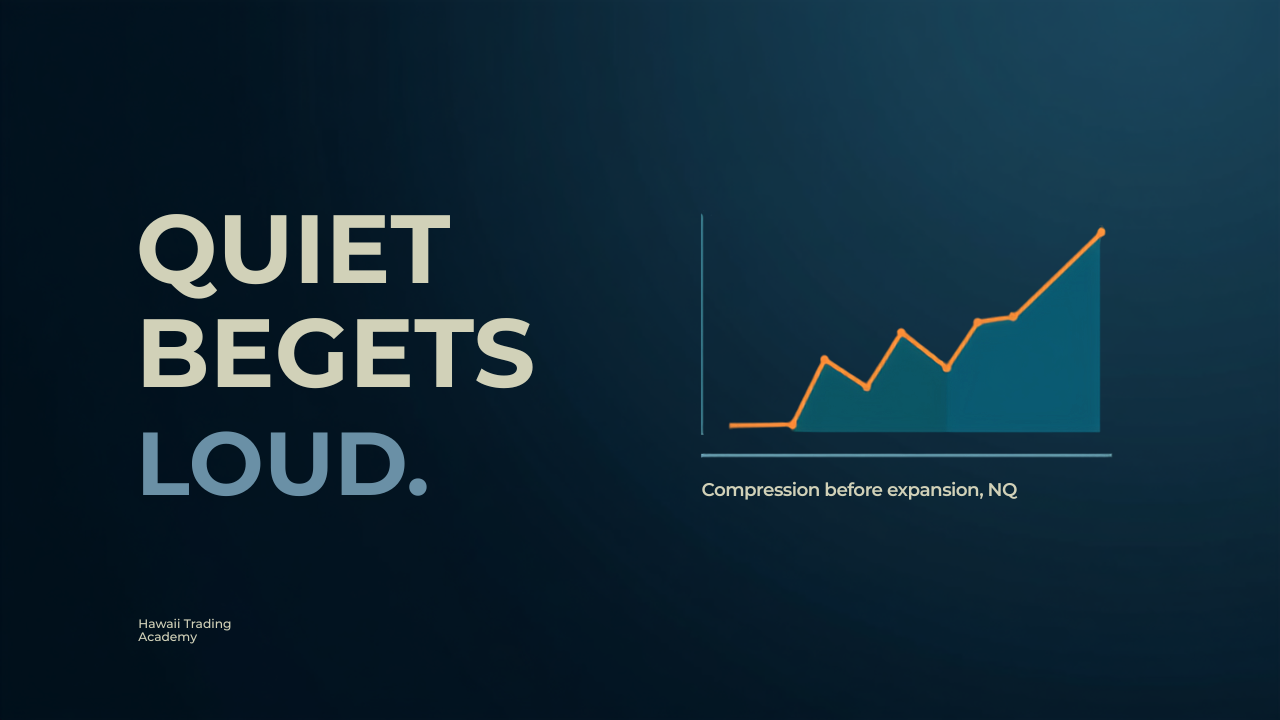
A dead, narrow day feels like nothing is happening. It is often the setup for the opposite. We tested it on NQ.
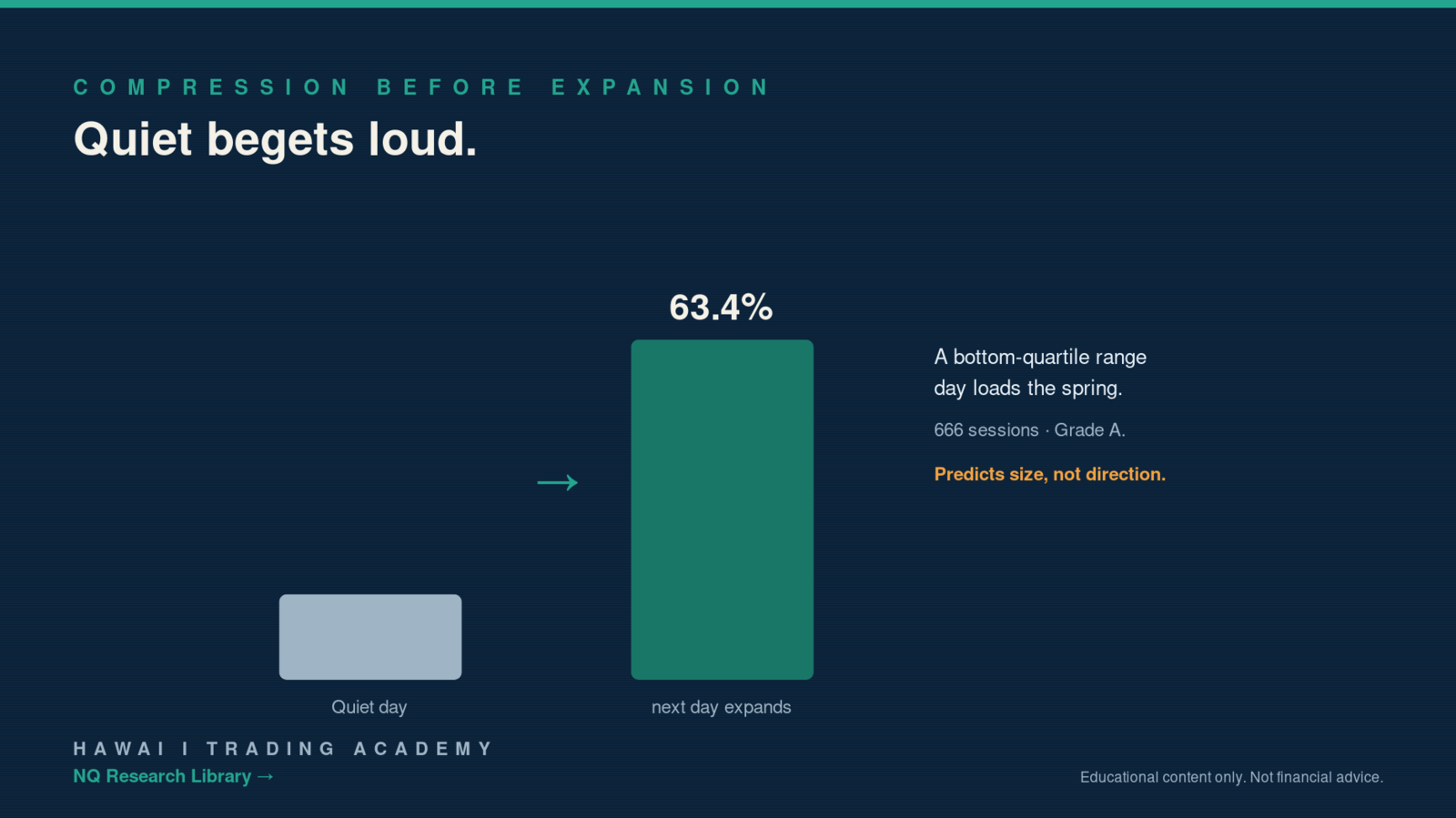
We took 666 bottom-quartile range days, the quietest sessions. The next regular session expanded 63.4% of the time. Significant in every session window we checked.
Why Quiet Loads the Spring
Volatility clusters and mean-reverts in size. A tight day is the market coiling. It rarely stays coiled. The energy that did not come out today tends to show up tomorrow.
This is one of the cleaner patterns in the whole library. It replicated across discovery, validation, and holdout. Grade A.
What It Actually Tells You
Here is the honest boundary. It predicts size, not direction. A quiet day says tomorrow is more likely to be a mover. It does not say up or down. That is a huge difference for how you plan.
What you do with it is prep. After a compressed day, widen your expectations. Do not get caught sizing for another dead session when the range is about to double.
The full com...
Downside Shocks Hit Harder and Linger Longer
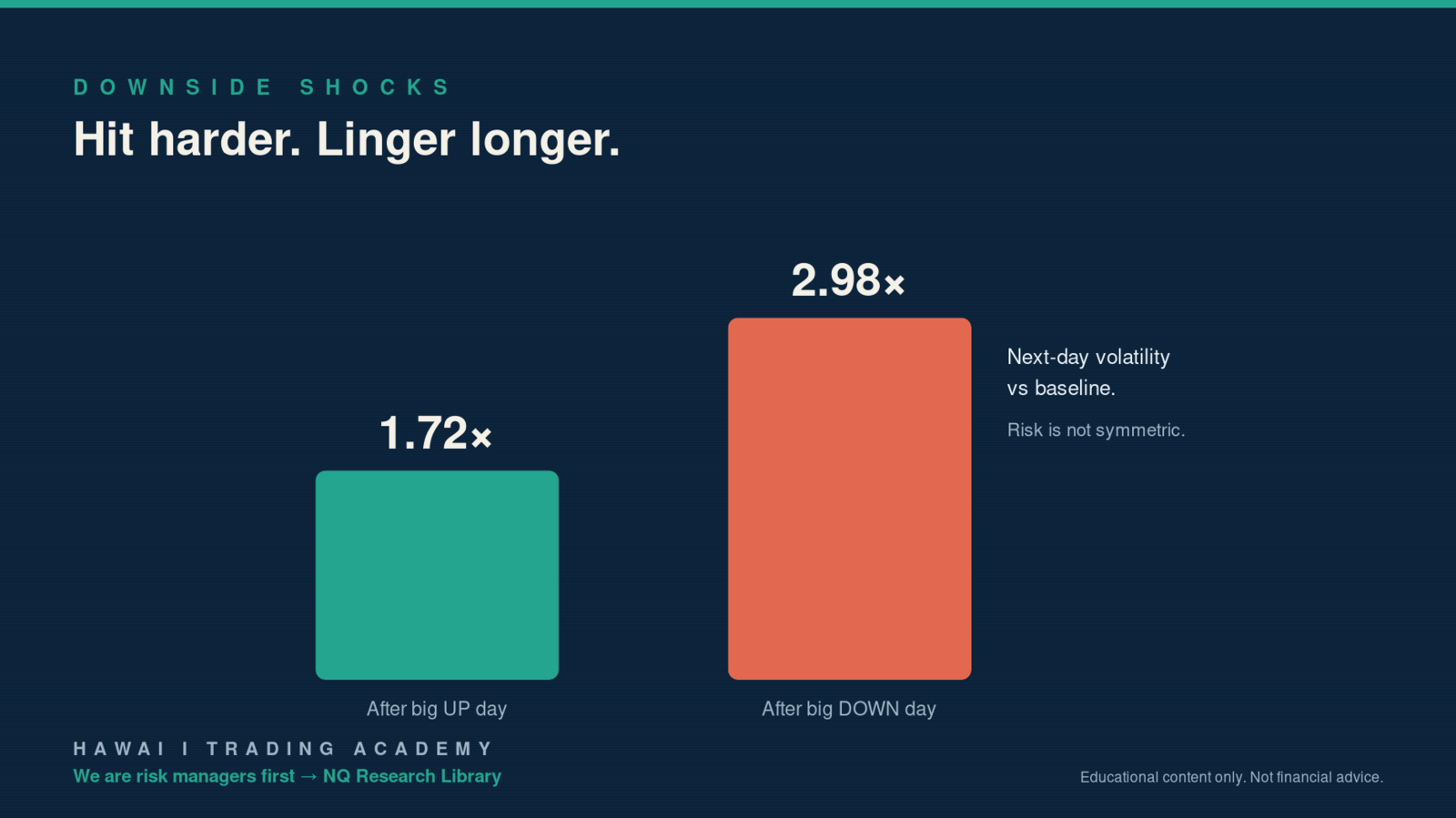
Up moves and down moves are not mirror images. Anyone who traded a real selloff knows it in their gut. We put a number on it for NQ.
We compared the largest down days to the largest up days. After a big down day, next-day volatility ran a median 2.98 times baseline. After a comparably big up day, only 1.72 times.
Fear Moves Faster Than Greed
Selloffs feed on themselves. Margin calls, forced selling, stops cascading. The tape stays wild the day after, and often longer. Rallies tend to be calmer and slower.
233 large-down days and 198 large-up days went into this. It is not a fluke of one crash. It is the shape of the market.
Why This Is a Risk Rule, Not a Trade
This will not tell you to buy or sell. It tells you the environment. The day after a big drop is a high-volatility environment whether you are long, short, or flat. That is when position sizing saves accounts.
Size the same after a selloff as you do on a calm day and you are taking on far more real risk than your positio...
AI Risk Management Tool: Built Dumber On Purpose
Everyone building AI trading tools wants a smarter one. Faster signals. Sharper predictions. A model that "learns" your account and adjusts on the fly.
We went the other direction.
When Glenn and I (Reid) sat down with Claude to build our own position-sizing risk tool, we gave it one job. Get dumber, not smarter. It's allowed to do less. It's never allowed to do more.
That sounds backwards until you remember what this tool touches. Money. Real risk. The kind of decision that, if it's wrong, doesn't just cost you a bad trade. It costs you the account.
When AI touches anything near your capital, "smart" is the wrong goal. "Constrained" is.
What Does "Constrain the Tool" Actually Mean?
Before we wrote a single line of code, we wrote a sentence.
"This tool may only ever REDUCE position size. It may never increase it."
We had Claude repeat that rule back to us before anything else happened. Then every design decision after that got checked against that one line. Every feature. Every...
The 9:30 Open Is the Loudest Five Minutes of the Day
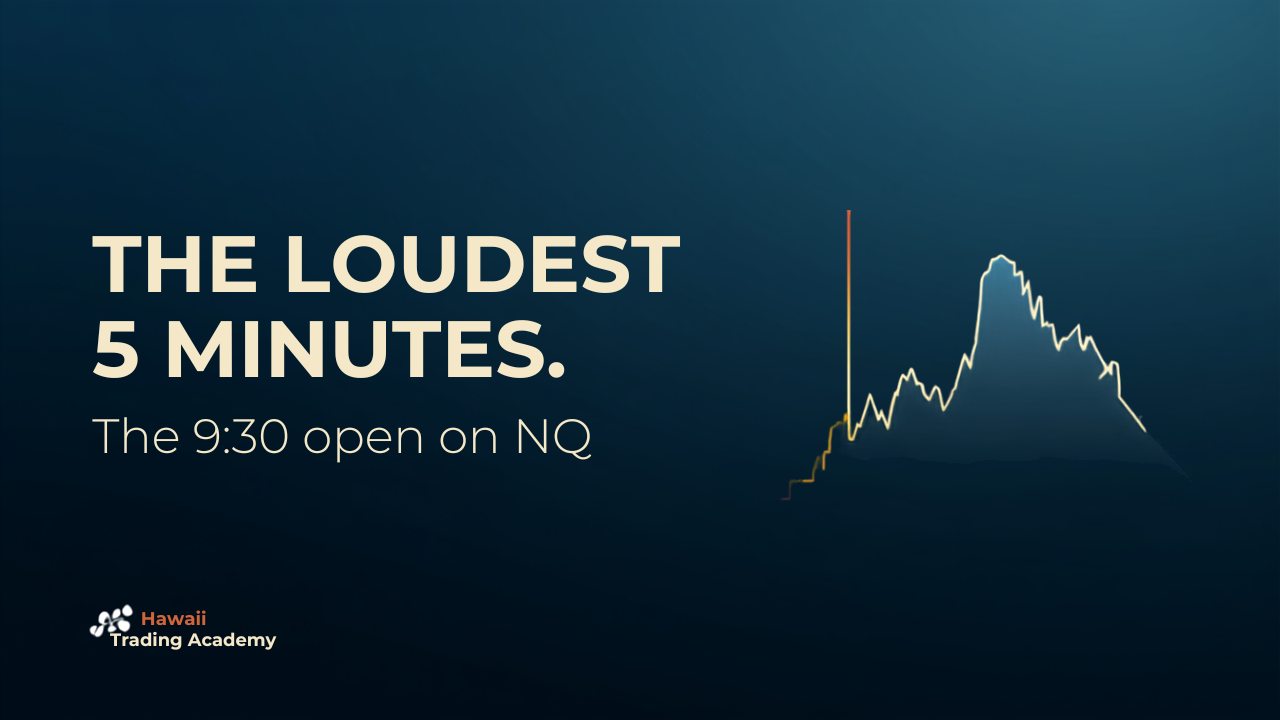
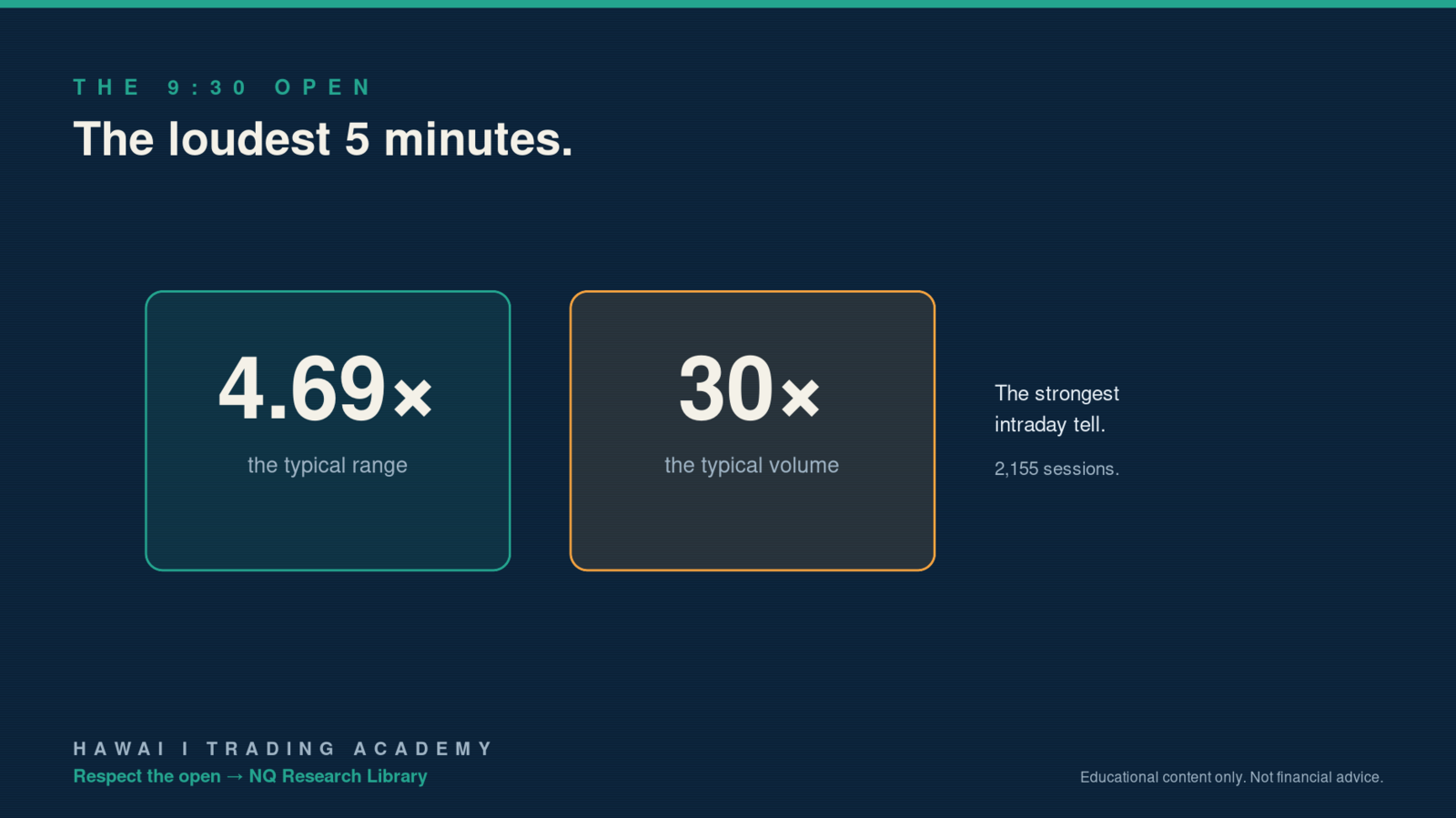
If you only knew one thing about intraday NQ, know this. The open is not like the rest of the day. We measured it across 2,155 sessions.
The 9:30 ET opening five-minute block ran at least 4.69 times the typical range and 30 times the typical volume. The pattern held across every test period.
The Strongest Intraday Tell
Nothing else on the clock comes close. The open is where the day's information gets priced, fast and loud. Volume floods in. Range explodes. Then it settles.
This is the single most reliable time-of-day fact in the NQ library. It is not subtle and it does not fade.
Respect It or Get Run Over
New traders love the open because it moves. That is exactly why it is dangerous. 30 times the volume means the fills are different, the spreads are different, and a normal-sized stop can get blown through in one candle.
The honest use is simple. If you trade the open, size for 5 times the range, not the calm midday range. If you cannot handle that, wait 15 minutes. The clock...
The Prop Firm Evaluation Math: Burn, EV, and the Real Odds
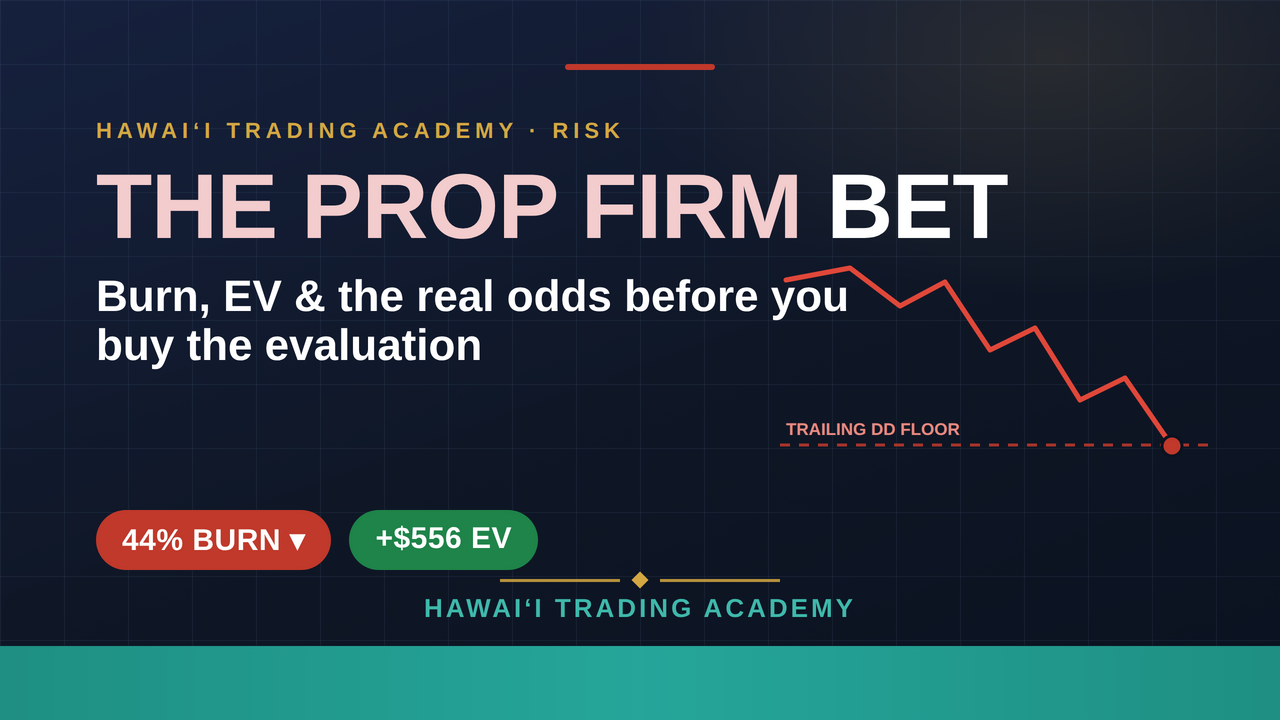
Before you buy another $100K evaluation, run two numbers. Not your win rate. Not your favorite setup. Two numbers decide whether that challenge is a smart bet or a slow leak: how often the account dies before it pays, and what one attempt is worth on average.
At Hawaiʻi Trading Academy, we teach Hawaii trading education the same way we trade. Risk first. A prop firm evaluation is a risk decision, and most traders make it on hope. You see the funded-account dream. You see the small fee. You click buy. The math tells a calmer, more useful story. Let’s run it.
What is “burn” on a prop firm evaluation?
Every evaluation ticket ends one of three ways, and the three always add up to 100%. Path one, it pays. You hit the target, clear the rules, get funded. Path two, it burns. The account gets knocked out before you finish. Path three, it times out. The window closes with no pass and no knockout.
Burn is the one that kills accounts before they pay. Take a common setup. A $100K evaluation wi...
We Tested 99 NQ Edges. Zero Survived the Data.
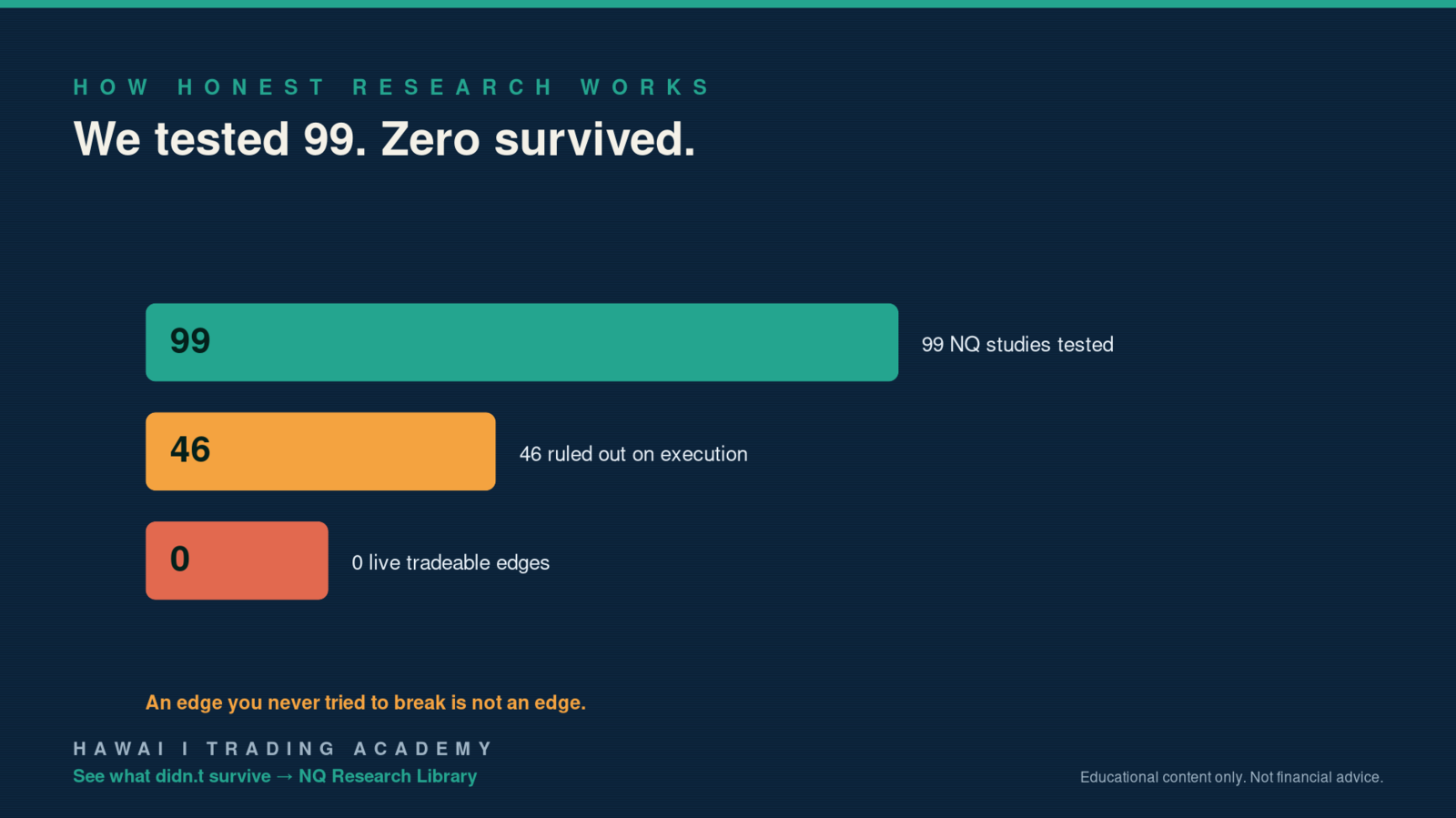
We ran 99 separate studies on NQ futures. Big samples too. One pulled from 2.07 million overnight minutes. Another from 3,883 regular-hours sessions. Then we audited every one for a live, tradeable edge.
The number that survived? Zero. Not one.
Sounds like a bad week. It’s the opposite. This is what honest research looks like. It’s also why we don’t sound like every other trading channel. We’re coaches who trade, not salespeople who teach. The new NQ Research Library inside Net Alpha Pro is 99 receipts to prove it.
Why Publish Research That Found No Edge?
Most trading content shows you the winners and buries the graveyard. We built the library the other way. Every study lists its question, its sample size, its result, and its caveat. Then a September 1 audit sorted all 99 into plain buckets. 46 closed as null or ruled out on execution. 25 were useful only as risk-and-range context. The rest were descriptive structure or forward watchlist leads.
Read that again. Forty-six popular...
Trading Psychology: The One Lesson Behind a Month of Building With AI
Everyone wants one clean result. One backtest that prints green top to bottom. One test suite that passes on the first run. One confident answer from an AI assistant that settles the question so you can stop worrying about it.
We think that want is exactly backwards.
A single good result is never proof. It's a starting point. And if you stop there, you're not managing risk. You're hoping.
Why Do Traders (and Builders) Trust One Good Number?
Because one clean number feels like relief. The backtest worked, so you move on. The code shipped, so you stop testing it. Claude gave you a confident-sounding answer, so you stop asking questions.
This month we walked you through real lessons from building HTA's tools and testing our own strategies alongside Claude. Our Edge & Strategy posts told you straight. We tested 47 strategies. Zero survived full verification.
Every single one looked good at some point. A clean equity curve. A promising win rate. One number that made us want to believe...
Passing Tests ≠ A Working Tool: Our AI Trading Tool Audit Checklist
"If the tests pass, the tool works." That's the assumption almost everyone makes about AI-built software. We made it too. For about twenty minutes.
Earlier this year we had Claude build us a position-sizing guardrail tool. Something to catch us before we sized a trade too big. The first version came back looking sharp. Every test passed. The documentation read like a senior engineer wrote it on a good day. Our gut said ship it.
We didn't. And that decision is the whole point of this post.
What Was A "Perfect" Build Actually Hiding?
I (Reid) run point on our AI builds, so I was the one staring at that first version, ready to call it done. Then we did what we tell every student to do with a new strategy before it touches real money. We audited it instead of trusting it.
What we found wasn't a small bug. It was three of them, stacked underneath a shiny surface.
The tool was reading from a dead data file. A source that no longer existed in the pipeline it was supposedly checking. Run...