The 9:30 Open Is the Loudest Five Minutes of the Day
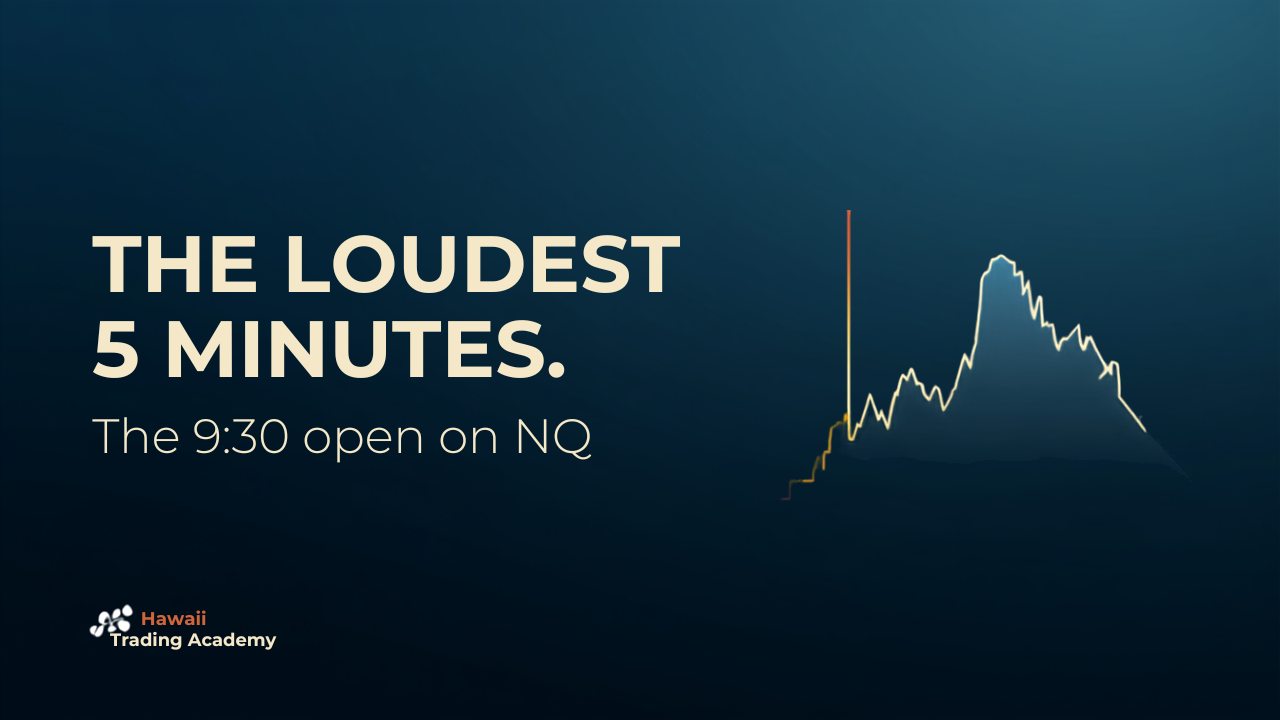
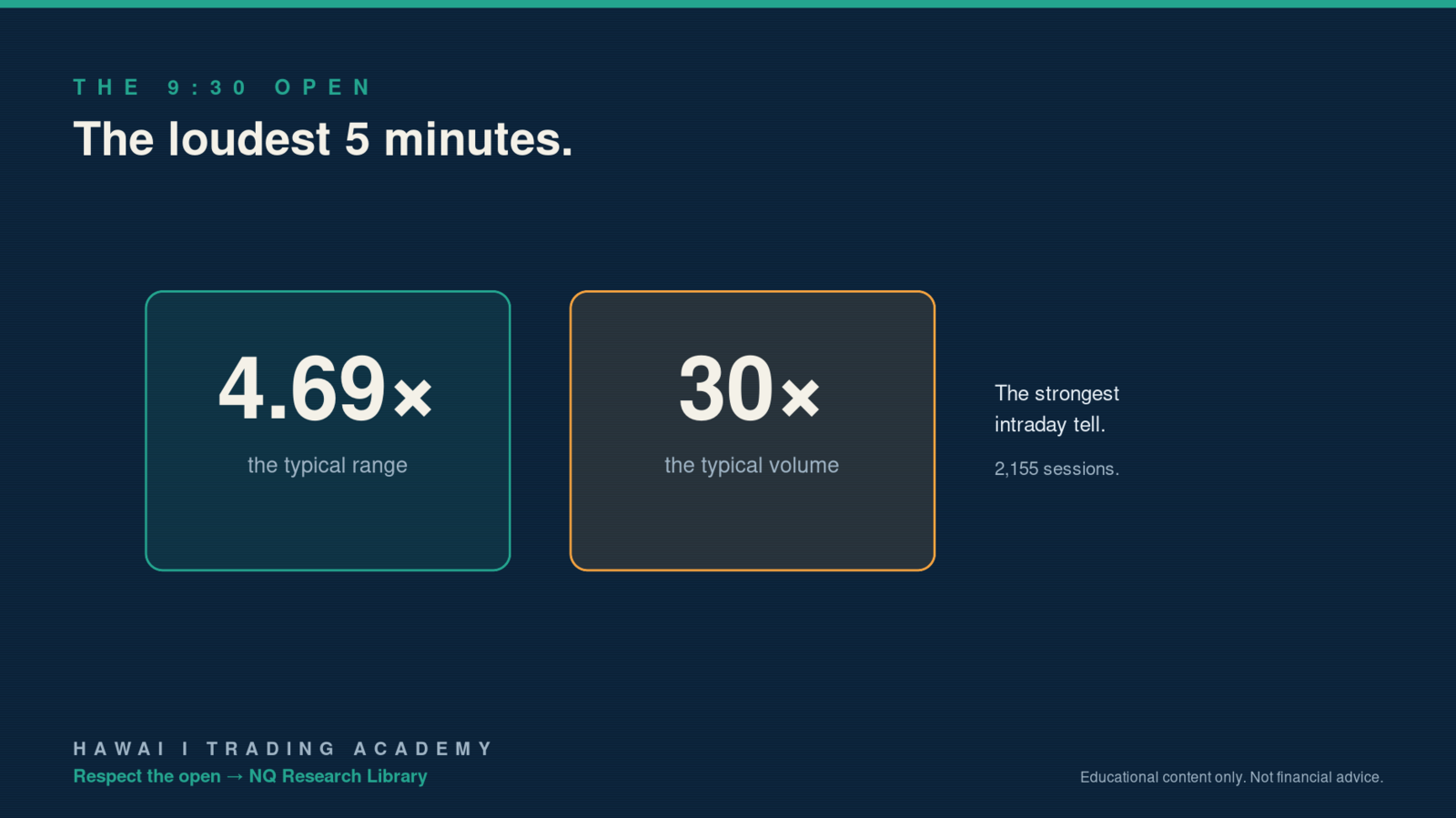
If you only knew one thing about intraday NQ, know this. The open is not like the rest of the day. We measured it across 2,155 sessions.
The 9:30 ET opening five-minute block ran at least 4.69 times the typical range and 30 times the typical volume. The pattern held across every test period.
The Strongest Intraday Tell
Nothing else on the clock comes close. The open is where the day's information gets priced, fast and loud. Volume floods in. Range explodes. Then it settles.
This is the single most reliable time-of-day fact in the NQ library. It is not subtle and it does not fade.
Respect It or Get Run Over
New traders love the open because it moves. That is exactly why it is dangerous. 30 times the volume means the fills are different, the spreads are different, and a normal-sized stop can get blown through in one candle.
The honest use is simple. If you trade the open, size for 5 times the range, not the calm midday range. If you cannot handle that, wait 15 minutes. The clock...
The Prop Firm Evaluation Math: Burn, EV, and the Real Odds
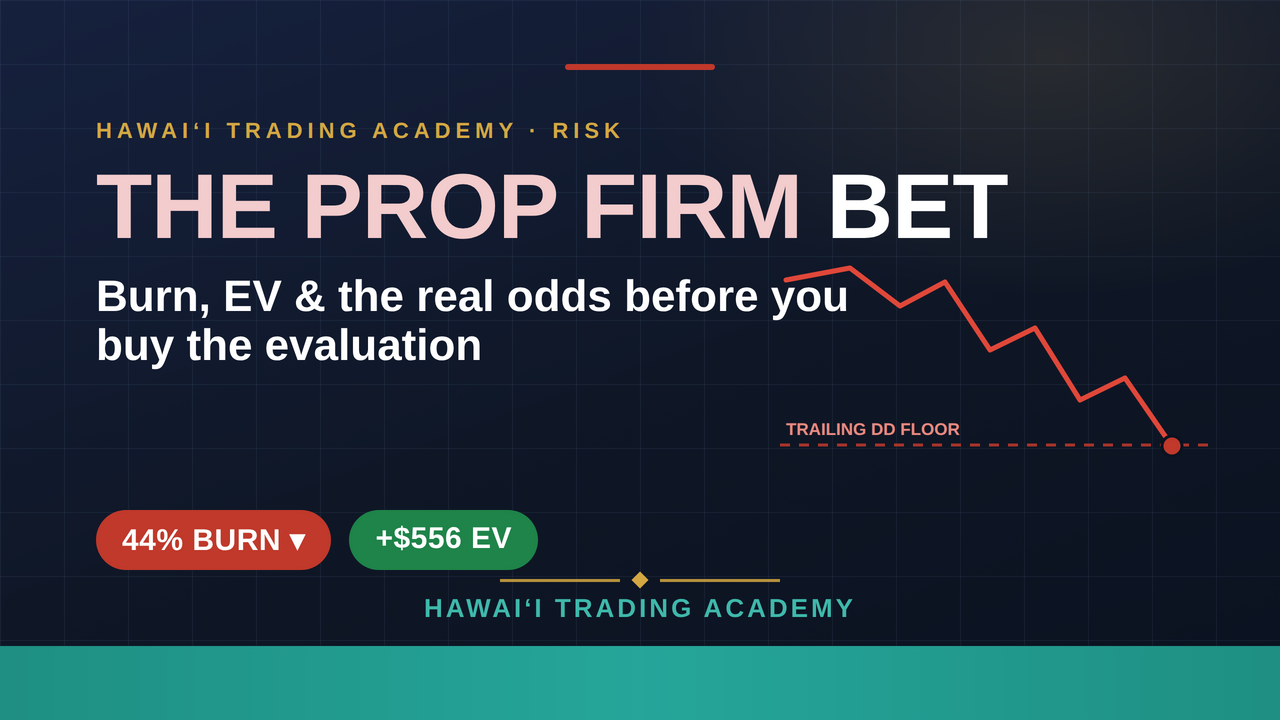
Before you buy another $100K evaluation, run two numbers. Not your win rate. Not your favorite setup. Two numbers decide whether that challenge is a smart bet or a slow leak: how often the account dies before it pays, and what one attempt is worth on average.
At Hawaiʻi Trading Academy, we teach Hawaii trading education the same way we trade. Risk first. A prop firm evaluation is a risk decision, and most traders make it on hope. You see the funded-account dream. You see the small fee. You click buy. The math tells a calmer, more useful story. Let’s run it.
What is “burn” on a prop firm evaluation?
Every evaluation ticket ends one of three ways, and the three always add up to 100%. Path one, it pays. You hit the target, clear the rules, get funded. Path two, it burns. The account gets knocked out before you finish. Path three, it times out. The window closes with no pass and no knockout.
Burn is the one that kills accounts before they pay. Take a common setup. A $100K evaluation wi...
How We Try to Break an Edge Before We Trust It
Here is a stat that should be a trade. In NQ, the first-hour direction matched the closing direction 71.7% of the time, across 2,654 sessions. And a median 59.4% of the whole day's range already existed after that first hour.
Read that fast and you would bet the farm. Follow the first hour, hold to the close, print money.
Our audit ruled it out. On purpose.
Why We Try to Break Our Own Ideas
71.7% agreement sounds like a coin that lands your way three times out of four. But direction agreement is not a trade. When you add the real entry, a real stop, and the cost of getting in and out, the translation from pattern to P&L is where most edges die. This one got flagged failed on execution for exactly that reason.
That is the job of research done right. Not to find things that look good. To find the ones that survive being attacked.
The Whole Library Works This Way
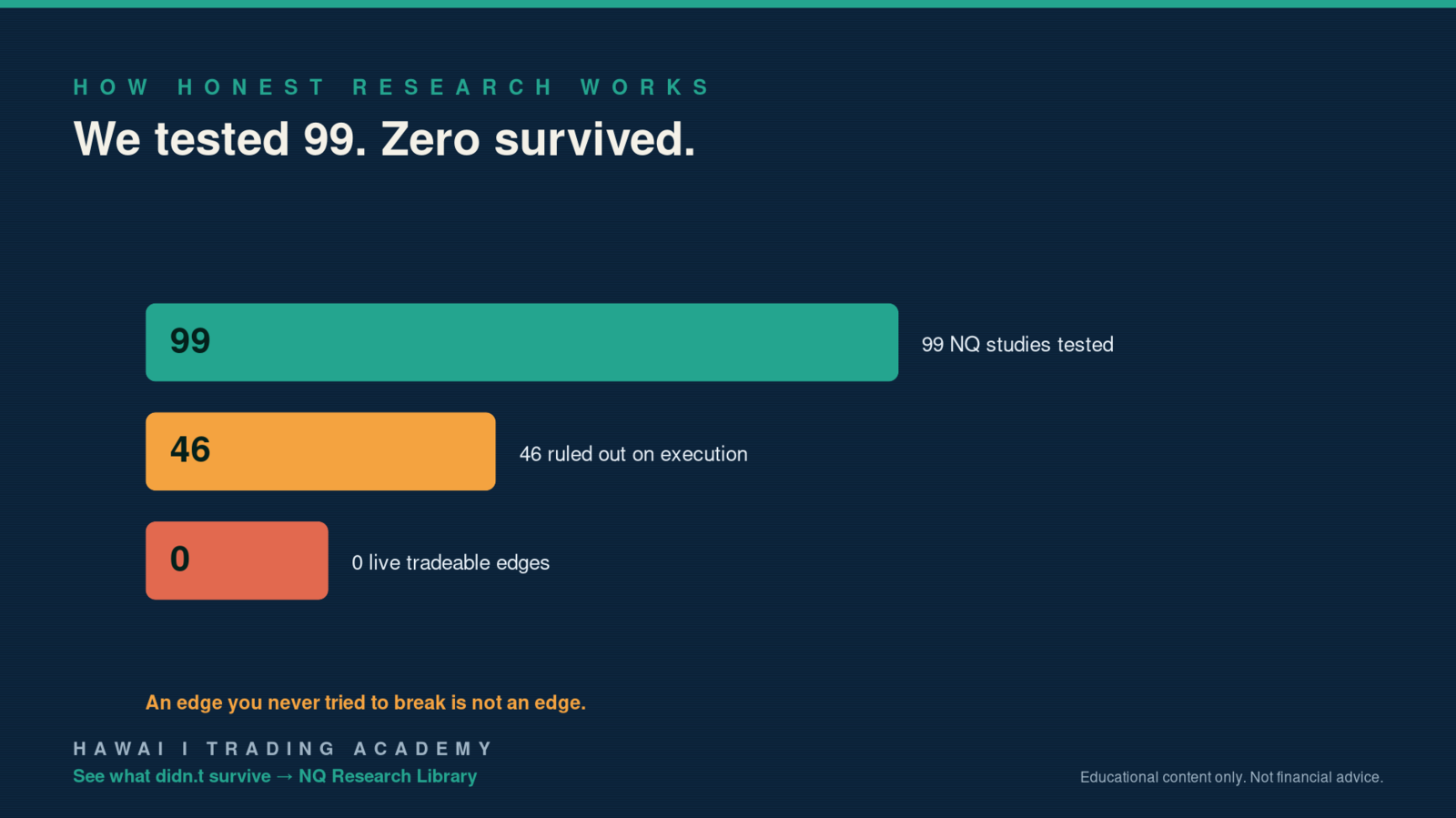
We ran 99 NQ studies. A September audit admitted zero of them as a live tradeable edge. 46 were closed as null or fail...
You Don't Have to Wake Up at 3AM to Trade From Hawaii

A trader hopped on a call with us this week and opened with one question before we could even say hello: "Do I have to wake up at 3am to do this?"
Short answer: no.
Long answer is this post. Because that question is the reason a lot of people in Hawaii never start. They picture the New York open, they do the time-zone math, they see 4:30am on the clock, and they close the tab. The market feels like it belongs to the mainland. It doesn't. You just have to know where the doors are.
Why does everyone think Hawaii traders have to be up before sunrise?
Because the loudest trading content on the internet is built around the New York stock market open. 9:30am Eastern. In Hawaii that's 3:30am in winter and 4:30am when the mainland is on daylight time. If the only market you know is the one on CNBC, then yes, trading from the islands looks like a job for insomniacs.
Here's what that content leaves out. The stock market keeps banker's hours. Futures don't.
How many hours a day are futures ...
We Tested 99 NQ Edges. Zero Survived the Data.
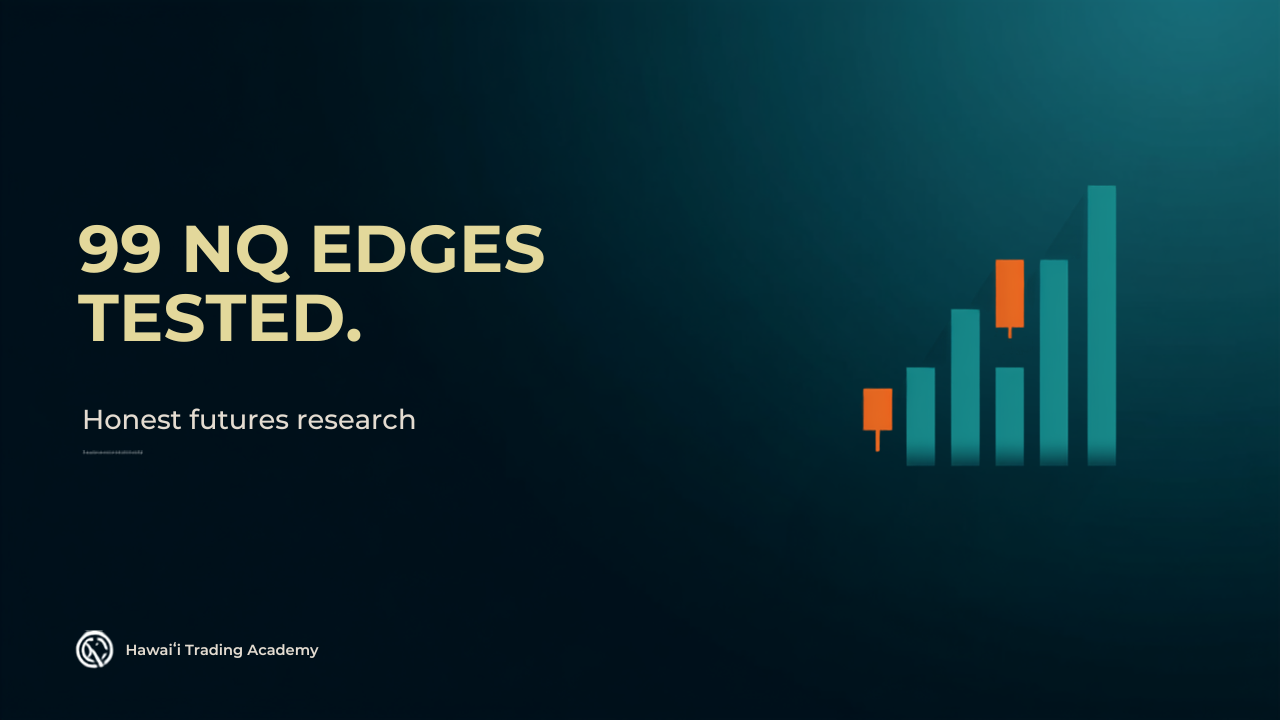
We ran 99 separate studies on NQ futures. Big samples too. One pulled from 2.07 million overnight minutes. Another from 3,883 regular-hours sessions. Then we audited every one for a live, tradeable edge.
The number that survived? Zero. Not one.
Sounds like a bad week. It’s the opposite. This is what honest research looks like. It’s also why we don’t sound like every other trading channel. We’re coaches who trade, not salespeople who teach. The new NQ Research Library inside Net Alpha Pro is 99 receipts to prove it.
Why Publish Research That Found No Edge?
Most trading content shows you the winners and buries the graveyard. We built the library the other way. Every study lists its question, its sample size, its result, and its caveat. Then a September 1 audit sorted all 99 into plain buckets. 46 closed as null or ruled out on execution. 25 were useful only as risk-and-range context. The rest were descriptive structure or forward watchlist leads.
Read that again. Forty-six popular...
Fed Day Whipsaws: Why Chasing the First Move Burns Accounts
Friday handed traders another live lesson. Fed Chair Kevin Warsh stepped up for his first Jackson Hole keynote, and the wires lit up. He said this summer's PCE and CPI readings were better than expected, but they do not tell him underlying inflation has meaningfully improved. Translation for the tape: the door to a rate hike next month cracked open. Chips gave back most of Thursday's Nvidia pop, and the Nasdaq closed lower.
If you traded the first headline print, you probably got faked out. That was not bad luck. That is what a Fed day does.
Why does NQ whipsaw so hard around Fed speakers?
An event like a Warsh speech or an FOMC decision dumps a burst of information into the market in seconds. Algorithms react first, they react fast, and they often react in both directions before the tape settles. You get a violent push one way, a snap back, then sometimes a third move that finally sticks.
That first move is the least reliable bar of the day. It is a knee-jerk, not a decision. NQ i...
NQ Futures Research: Stop Guessing and Ask the Data
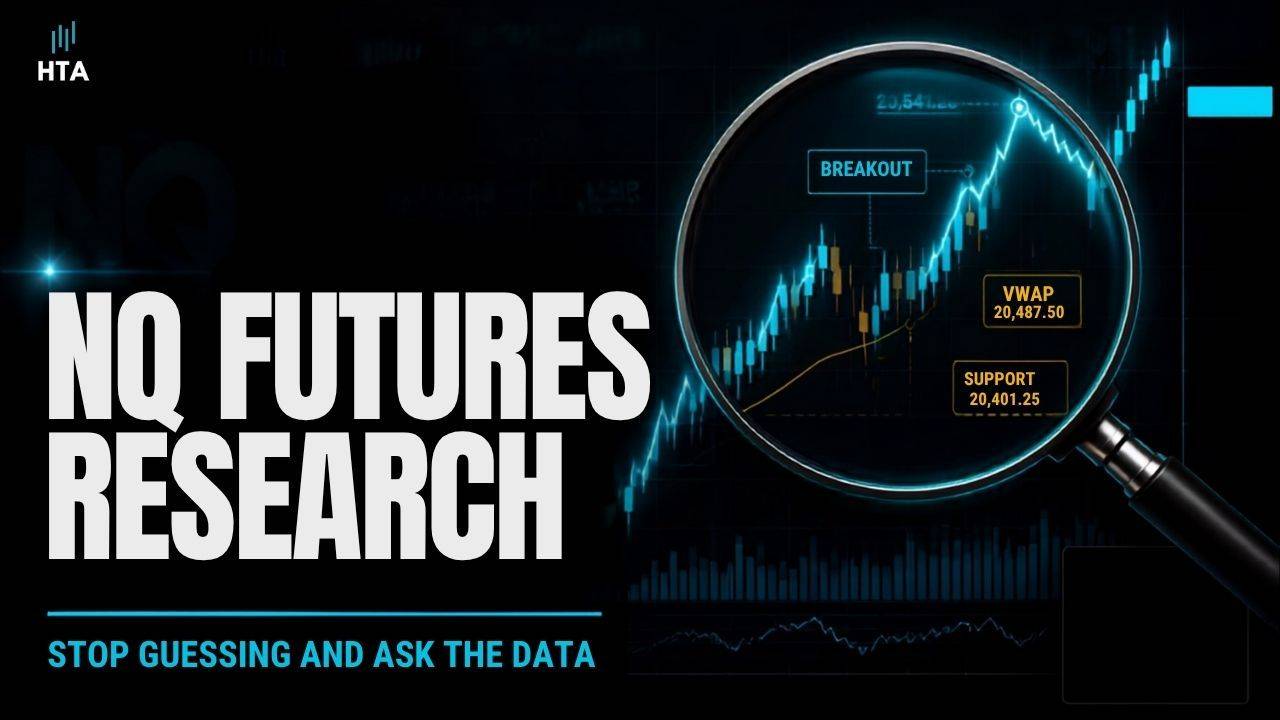
Most trading content answers the wrong question. It tells you what should happen next. Good NQ futures research starts somewhere else: what actually happened the last time this condition showed up, how often did it happen, and how wide was the range of outcomes?
That difference sounds small, but it changes the way you prepare. A chart opinion gives you a story. Research gives you a distribution, a sample size, a definition, and a reason to know when the story is too weak to trust.
Why HTA Is Building an NQ Futures Research Lab
At Hawai'i Trading Academy, our core pillars have always been Risk Management, Edge & Strategy, and Psychology & Process. Research sits right in the middle of all three. It helps you test whether an edge is real, keeps risk expectations grounded, and gives your brain something better than recency bias to lean on when the market gets loud.
We already teach traders to backtest before they trust a setup. In our guide on using TradeZella for backtesting, the poin...
NQ Futures Statistics: How to Read the Data Correctly
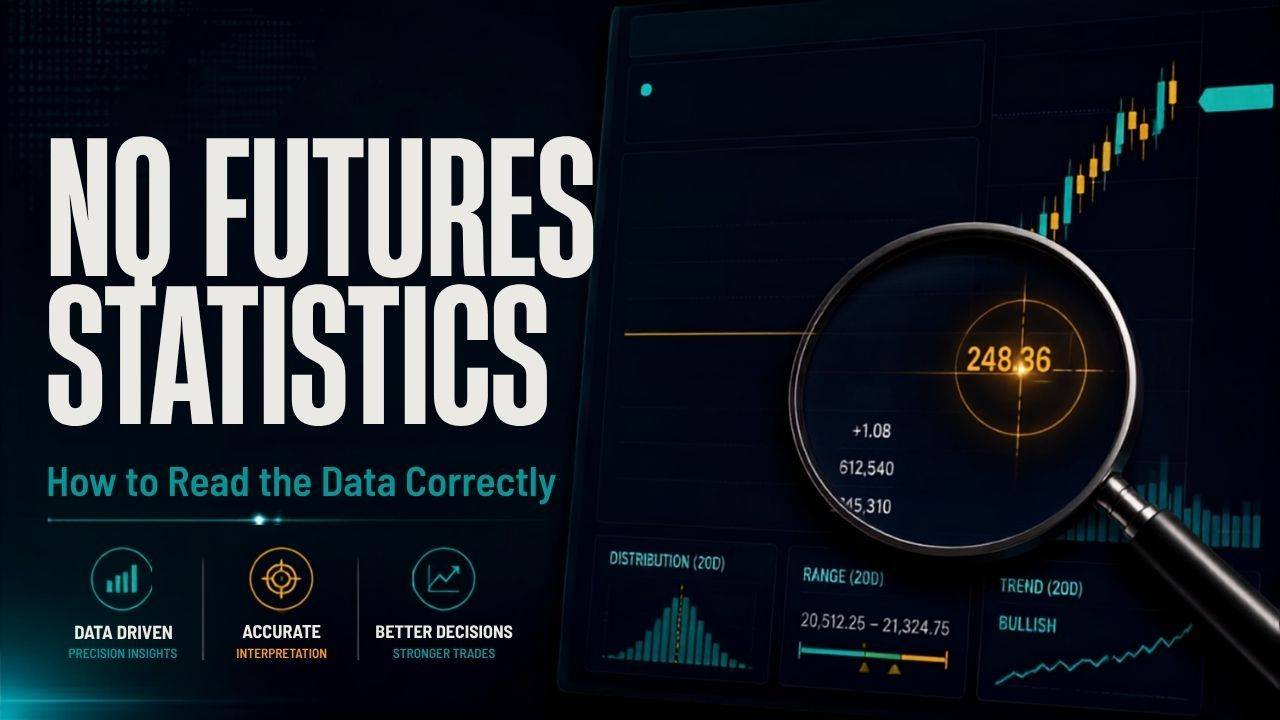
A trading statistic can be technically correct and still lead you to a bad decision. That is the problem with screenshots that say '72% win rate' and stop there. The number might be real, but without the sample, condition, distribution, and downside, you do not know what it actually means.
If the HTA Research Lab is going to be useful, traders need to know how to read NQ futures statistics without turning historical probabilities into predictions. Here is the framework we use.
1. Start With the Definition, Not the Percentage
Before you look at a result, define the event. 'Gap fill' sounds obvious until two traders use different closes, different opens, different sessions, and different thresholds. 'Trend day' is even worse. One person means close above open. Another means one-directional price action with shallow pullbacks. Those are different studies.
A clean research page should tell you exactly how the condition was measured. For NQ, session boundaries matter. So do the timefram...
HTA Research Lab: Evidence Over Opinions for Traders
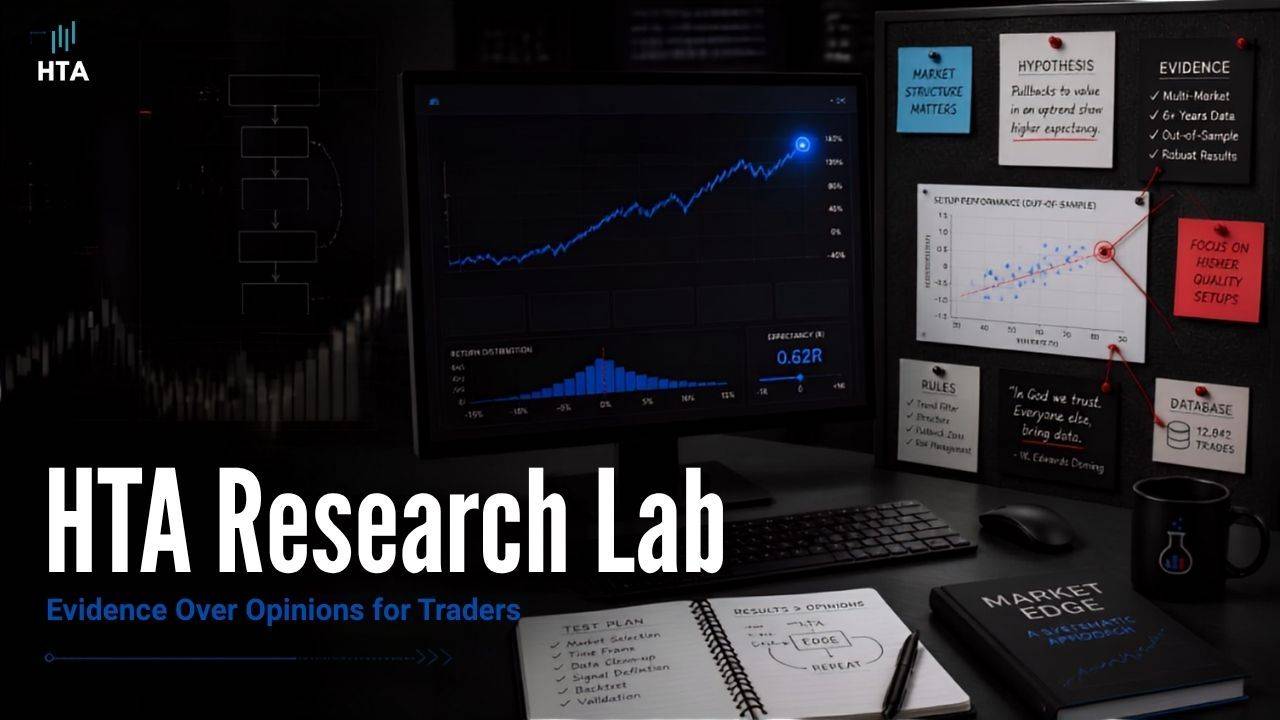
Today we are opening the HTA Research Lab with one simple idea: stop guessing and ask the data.
There is no shortage of futures opinions online. There are calls, predictions, screenshots, hot takes, and clean explanations written after the move already happened. What traders need more of is transparent futures trading research that shows the sample, the condition, the result, and the limitation in the same place.
What the HTA Research Lab Is
The Research Lab is a public market-research experience built around questions traders actually ask about NQ futures. Instead of opening a page and being told what to trade, you choose the market context you care about and inspect what happened historically under a frozen definition.
The MVP starts with NQ only. That is intentional. We would rather launch a smaller set of clear, useful studies than dump 100 research cards into an interface and make traders hunt for the point.
You can explore five main timeframes: 5-minute, 15-minute, 1-hour, 4...
Bad News, Good Day: Why a Weak Jobs Report Sent Stocks Up
The economy lost 23,000 jobs in July. Wall Street threw a party. The S&P 500 closed at a record 7,757, the Nasdaq jumped about 1.3%, and NQ futures ran up roughly 1.2% on the day.
If that makes no sense to you, good. It means you are paying attention. A shrinking job market should scare investors. Instead, it thrilled them. So why did stocks rip on obviously bad news?
The answer is the single most useful thing a new trader can learn about how markets actually work. It is not the number that moves price. It is what the number does to the Fed.
Wait, the economy shrank and stocks went up?
Let's set the table. Economists expected around 83,000 new jobs in July. Instead, payrolls fell by 23,000, and prior months were revised down hard. On the surface, that is a soft labor market flashing a warning.
The day before, futures markets put the odds of a September rate hike near 55%. Within minutes of the report, those odds collapsed toward zero. Traders decided the Fed now has cover to leave...