The Weekend Review Ritual That Keeps Traders Funded
Let’s be honest, you’re probably overtrading.
Not because you’re undisciplined. Because you’re bored. The market goes quiet, the setup you wanted never shows up, and that itch to do something takes over. So you take the trade that isn’t there. That’s the whole mechanism, and it’s the single most common way we watch good traders bleed out.
The 2026 psychology research says the same thing we see in coaching: overtrading, driven by boredom, action-addiction, and the false math that more trades equals more profit, is the top failure mode for retail traders. And the cleanest antidote isn’t a new indicator. It’s a habit you run on the weekend, when the market is closed and can’t tempt you.
What do the best traders actually do on Saturday?
Not stare at charts. That surprises people.
The weekend isn’t for trading, it’s for reviewing the week you already traded. In our community the ritual has three parts, and none of them are exciting. That’s the point.
Step one: review the tape you alre...
Trading Psychology: The One Lesson Behind a Month of Building With AI
Everyone wants one clean result. One backtest that prints green top to bottom. One test suite that passes on the first run. One confident answer from an AI assistant that settles the question so you can stop worrying about it.
We think that want is exactly backwards.
A single good result is never proof. It's a starting point. And if you stop there, you're not managing risk. You're hoping.
Why Do Traders (and Builders) Trust One Good Number?
Because one clean number feels like relief. The backtest worked, so you move on. The code shipped, so you stop testing it. Claude gave you a confident-sounding answer, so you stop asking questions.
This month we walked you through real lessons from building HTA's tools and testing our own strategies alongside Claude. Our Edge & Strategy posts told you straight. We tested 47 strategies. Zero survived full verification.
Every single one looked good at some point. A clean equity curve. A promising win rate. One number that made us want to believe...
Passing Tests ≠ A Working Tool: Our AI Trading Tool Audit Checklist
"If the tests pass, the tool works." That's the assumption almost everyone makes about AI-built software. We made it too. For about twenty minutes.
Earlier this year we had Claude build us a position-sizing guardrail tool. Something to catch us before we sized a trade too big. The first version came back looking sharp. Every test passed. The documentation read like a senior engineer wrote it on a good day. Our gut said ship it.
We didn't. And that decision is the whole point of this post.
What Was A "Perfect" Build Actually Hiding?
I (Reid) run point on our AI builds, so I was the one staring at that first version, ready to call it done. Then we did what we tell every student to do with a new strategy before it touches real money. We audited it instead of trusting it.
What we found wasn't a small bug. It was three of them, stacked underneath a shiny surface.
The tool was reading from a dead data file. A source that no longer existed in the pipeline it was supposedly checking. Run...
Building an AI Trading Risk Tool With Claude: The One Rule We Set Before Writing Any Code
Our position-sizing tool sat quiet for 30 trades before we let it touch anything. It watched real trades come in. It logged what it would have told us to do. It changed nothing.
That wasn’t caution for caution’s sake. That was the plan from day one.
This is post one in a ten-part series on what we’ve actually learned building tools and testing strategies with Claude, Anthropic’s AI. Glenn and I aren’t AI developers by trade. We’re traders who started using Claude to build things we needed and couldn’t buy off the shelf. Some of what we built worked. Some of it didn’t, until we fixed how we were building it. This series is the honest version of that process. What to do, what not to do, no polish added.
Today’s post covers the do’s. Specifically, the three things that kept an AI-built risk tool from ever putting our account in danger, even while it was still rough around the edges.
What’s the One Rule That Comes Before Any Code?
I (Reid) handle most of the AI and content systems at ...
HTA Research Lab: Evidence Over Opinions for Traders
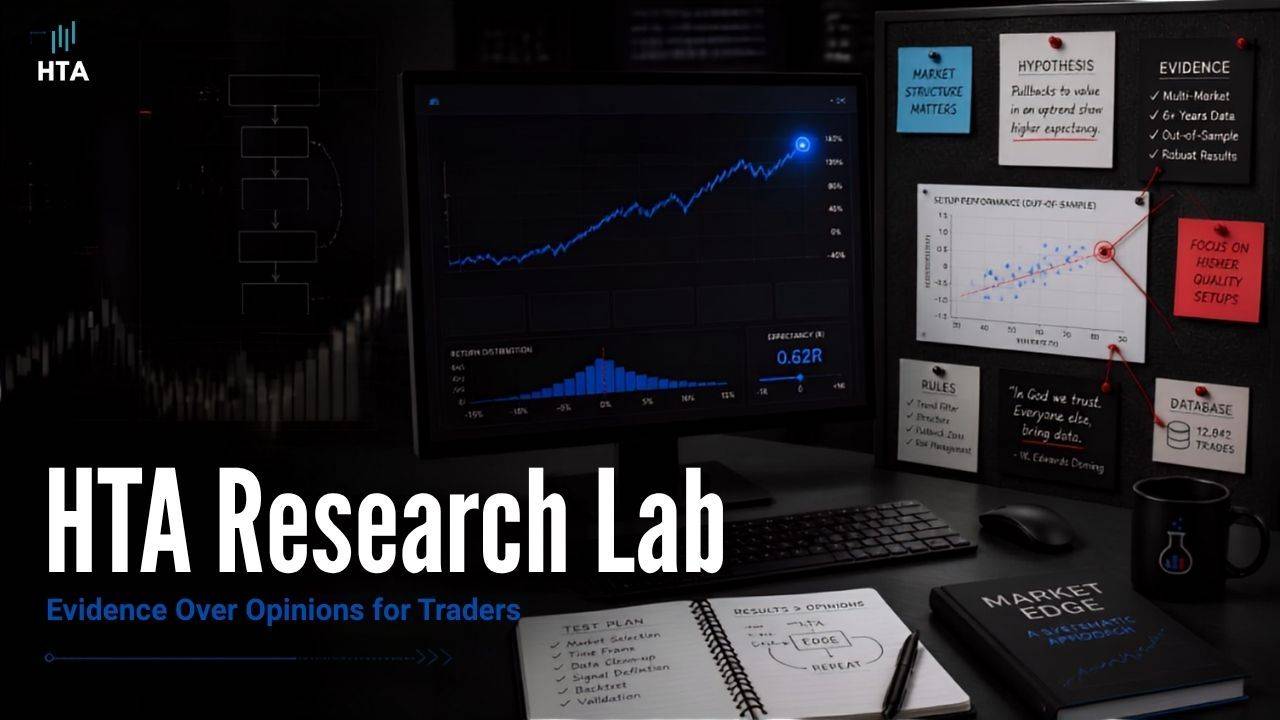
Today we are opening the HTA Research Lab with one simple idea: stop guessing and ask the data.
There is no shortage of futures opinions online. There are calls, predictions, screenshots, hot takes, and clean explanations written after the move already happened. What traders need more of is transparent futures trading research that shows the sample, the condition, the result, and the limitation in the same place.
What the HTA Research Lab Is
The Research Lab is a public market-research experience built around questions traders actually ask about NQ futures. Instead of opening a page and being told what to trade, you choose the market context you care about and inspect what happened historically under a frozen definition.
The MVP starts with NQ only. That is intentional. We would rather launch a smaller set of clear, useful studies than dump 100 research cards into an interface and make traders hunt for the point.
You can explore five main timeframes: 5-minute, 15-minute, 1-hour, 4...
Correlation Risk: Why Your Diversified Trades Aren't
Correlation Risk: Why Your Diversified Trades Aren't
You have three trades on: NQ long, AAPL calls, and a TQQQ position. You think you're diversified. You're not. You have one trade on, three times.
This is correlation risk. It's the invisible killer that turns a manageable losing day into a catastrophic one.
What Correlation Risk Actually Is
Correlation measures how closely two instruments move together. A correlation of 1.0 means they move in perfect lockstep. A correlation of 0 means they're independent. A correlation of -1.0 means they move in opposite directions.
NQ and ES? Correlation typically sits around 0.92-0.97. They're basically the same trade. NQ and AAPL? Around 0.85. NQ and TQQQ? Around 0.98. If you're long all three, you don't have three positions. You have one position, three times the size.
Why This Matters for Futures Traders
Say your risk model allows 2% total account risk at any given time. You put on NQ at 1% risk and ES at 1% risk. Your model says you're a...
The 2% Rule Is Wrong: How to Size for YOUR Account
The 2% Rule Is Wrong: How to Size for YOUR Account
You've heard it before: never risk more than 2% of your account on a single trade. The problem? It's generic. It works for nobody in particular.
The 2% rule is a starting point, not a destination. Your real position size depends on four things: account size, strategy type, your actual win rate, and your psychological tolerance for drawdown.
Account Size Changes Everything
Say you have a $10,000 account and you trade a strategy that averages 50 pips on ES futures. At 2% risk, you're risking $200 per trade. That's 4 pips. Good luck executing that without slippage eating you alive.
Now say you have a $100,000 account. 2% is $2,000. That's 40 pips of wiggle room. The 2% rule doesn't account for the minimum viable risk unit in YOUR market.
Strategy Type Demands Different Sizing
Mean reversion? Tight stops, quick exits, low win rate (40-50%), but high reward-to-risk. You can size more aggressively. Breakout trading? Wider stops, longe...
Trade Like a Business: Mark Douglas's Five Truths
A losing trade is a business expense. Read that again, because your gut hates it.
Your gut wants the loss to mean something, that you were wrong, that the market cheated you, that you need to make it back right now. That reaction feels like accountability. It’s actually the most expensive instinct in trading, and it’s the reason the trade after a loss is so often the worst one you take.
There’s a fix that’s almost thirty years old and still undefeated. Mark Douglas laid out five fundamental truths in Trading in the Zone, and a 2026 audit of funded traders found the ones who reviewed those truths consistently held a 22% higher Sharpe ratio than those who didn’t. Same charts. Same strategies. Different relationship with uncertainty.
We lean on this framework hard at Hawai’i Trading Academy, because psychology is the pillar most traders skip and the one that actually decides who survives.
What are Mark Douglas’s five truths?
They sound simple. They’re not easy. Here they are, plain:
...MNQ vs NQ: Which Nasdaq Futures Contract Should a Beginner Trade?
You want to trade Nasdaq futures but there are two contracts staring at you: NQ and MNQ. Same underlying index, same price action, completely different risk profiles. Picking the wrong one for your account size is one of the fastest ways to blow up before you learn anything.
Here is the breakdown so you can make the right call.
What Are NQ and MNQ?
Both contracts track the Nasdaq-100 Index. NQ is the E-mini Nasdaq-100, the full-size contract. MNQ is the Micro E-mini Nasdaq-100, exactly one-tenth the size of NQ. They trade on the same exchange (CME), during the same hours, with the same price movement. The only difference is how much each tick and each point costs you.
Contract Specs Side by Side
NQ (E-mini): $20 per point, $5 per tick (0.25 points), initial margin roughly $18,000+.
MNQ (Micro): $2 per point, $0.50 per tick (0.25 points), initial margin roughly $1,800+.
A 50-point move on NQ = $1,000. That same 50-point move on MNQ = $100. Same chart, same candles, ten times less...
RVOL + VWAP Trading Strategy: 64% Win Rate
RVOL + VWAP Mean Reversion: 4,672 Trades and a 64% Win Rate
This is our most consistent strategy for one specific scenario: shorting overextended moves on Crude Oil.
The RVOL + VWAP Mean Reversion strategy combines relative volume analysis with VWAP deviation to find high-probability mean reversion entries. It’s Strategy 4 in our Edge Playbook, and it’s the one our students ask about most.
The Data
Across 4,672 backtested trades: Win rate: 64%. The highest of any strategy in our playbook. When you combine that with a favorable R:R, the expectancy is strong and the equity curve is smooth.
The strategy works because RVOL (Relative Volume) acts as a confirmation filter. High RVOL at VWAP deviation means institutional participation — and institutions mean revert. Low RVOL at deviation? That’s noise. Skip it.
How It Works
Setup: Price extends 1+ standard deviations from VWAP while RVOL is above 1.5x average.
Entry: First sign of reversal — a rejection candle, a momentum shift, or a ...