AI Risk Management Tool: Built Dumber On Purpose
Everyone building AI trading tools wants a smarter one. Faster signals. Sharper predictions. A model that "learns" your account and adjusts on the fly.
We went the other direction.
When Glenn and I (Reid) sat down with Claude to build our own position-sizing risk tool, we gave it one job. Get dumber, not smarter. It's allowed to do less. It's never allowed to do more.
That sounds backwards until you remember what this tool touches. Money. Real risk. The kind of decision that, if it's wrong, doesn't just cost you a bad trade. It costs you the account.
When AI touches anything near your capital, "smart" is the wrong goal. "Constrained" is.
What Does "Constrain the Tool" Actually Mean?
Before we wrote a single line of code, we wrote a sentence.
"This tool may only ever REDUCE position size. It may never increase it."
We had Claude repeat that rule back to us before anything else happened. Then every design decision after that got checked against that one line. Every feature. Every...
The 9:30 Open Is the Loudest Five Minutes of the Day
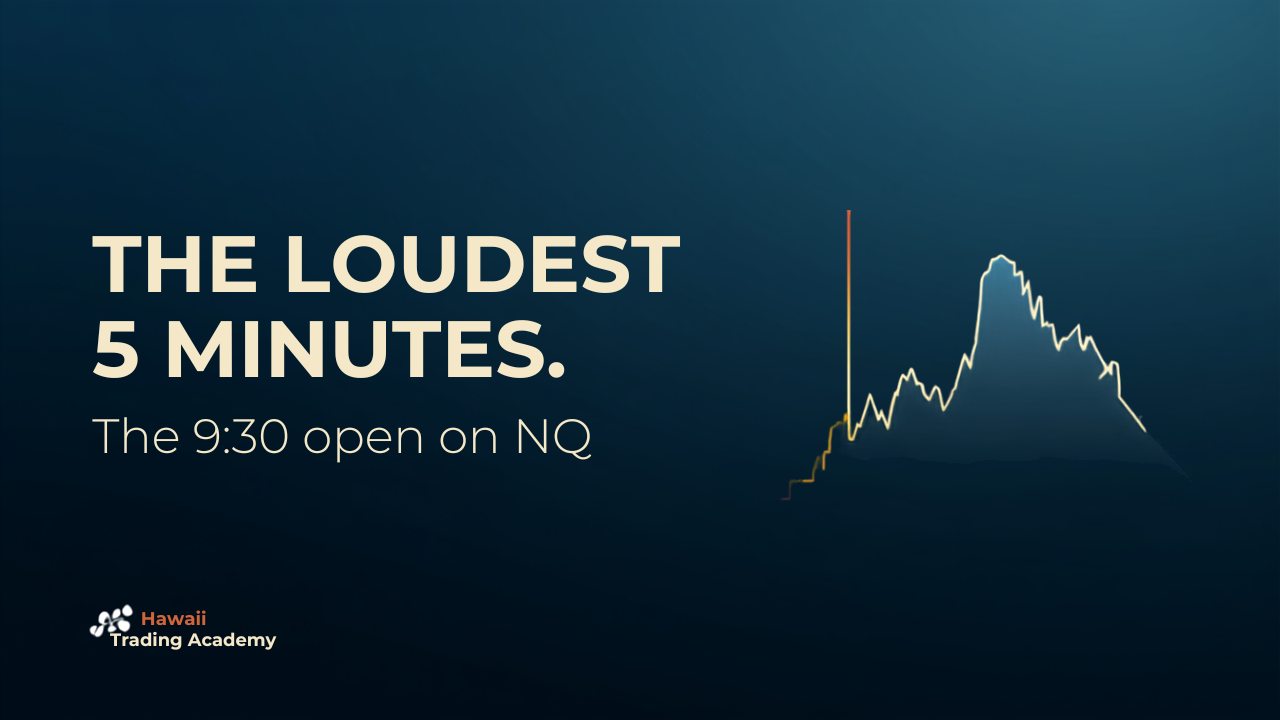
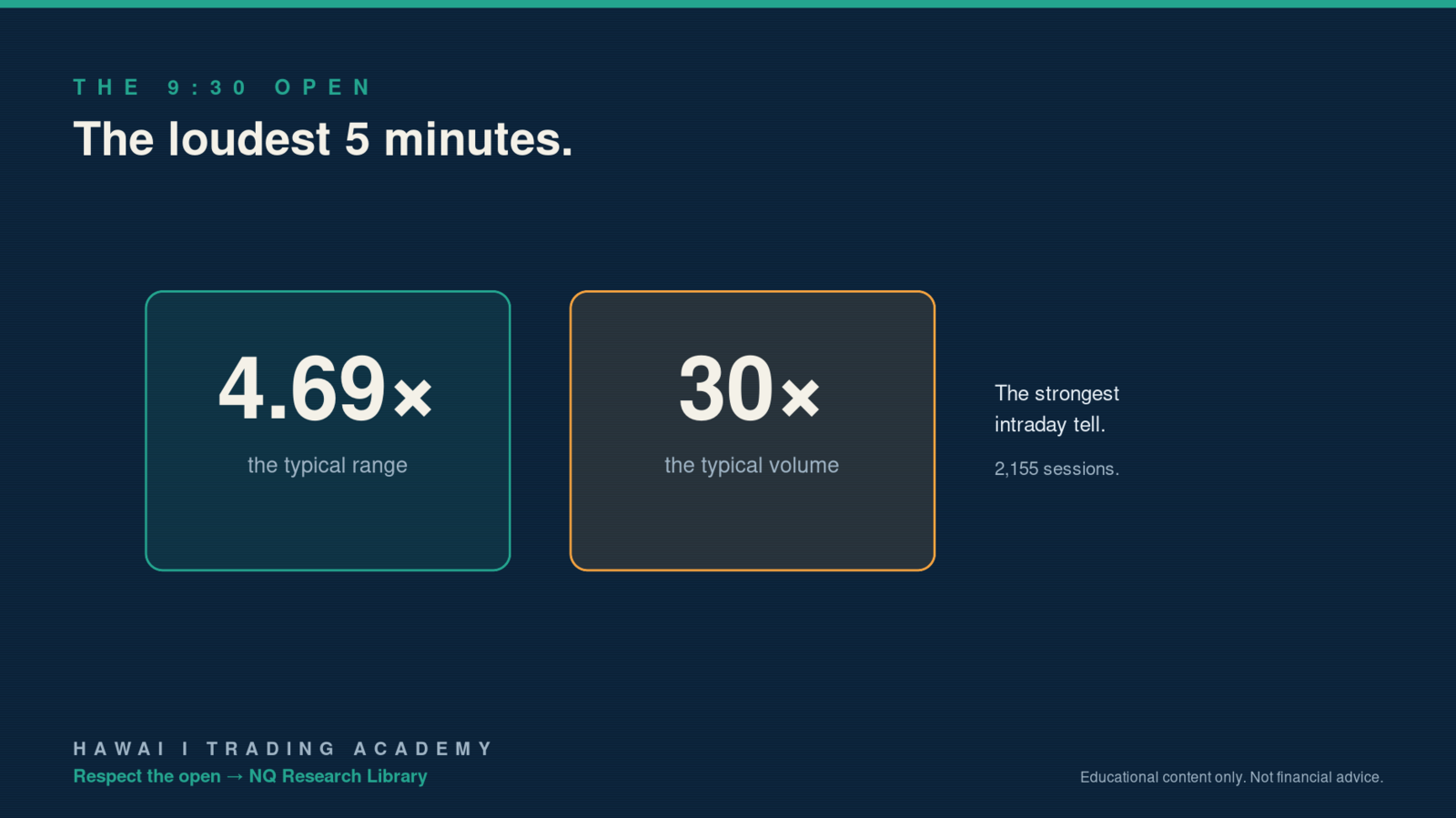
If you only knew one thing about intraday NQ, know this. The open is not like the rest of the day. We measured it across 2,155 sessions.
The 9:30 ET opening five-minute block ran at least 4.69 times the typical range and 30 times the typical volume. The pattern held across every test period.
The Strongest Intraday Tell
Nothing else on the clock comes close. The open is where the day's information gets priced, fast and loud. Volume floods in. Range explodes. Then it settles.
This is the single most reliable time-of-day fact in the NQ library. It is not subtle and it does not fade.
Respect It or Get Run Over
New traders love the open because it moves. That is exactly why it is dangerous. 30 times the volume means the fills are different, the spreads are different, and a normal-sized stop can get blown through in one candle.
The honest use is simple. If you trade the open, size for 5 times the range, not the calm midday range. If you cannot handle that, wait 15 minutes. The clock...
The Prop Firm Evaluation Math: Burn, EV, and the Real Odds
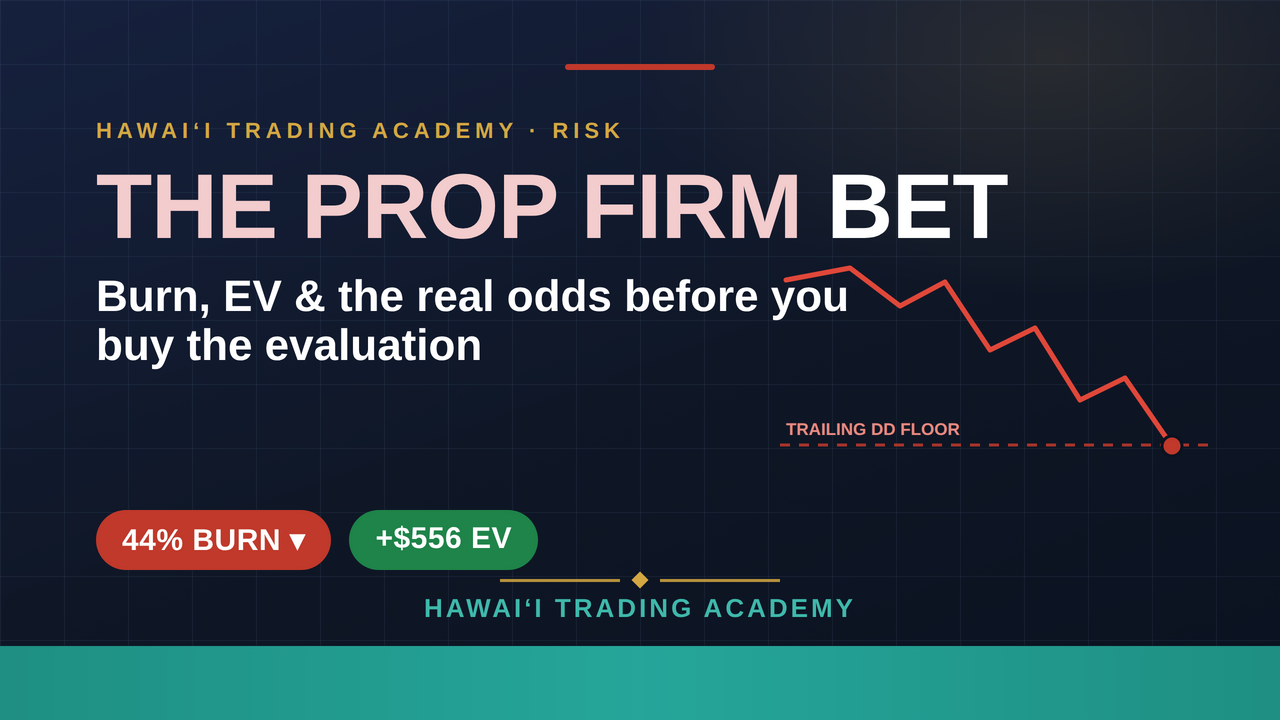
Before you buy another $100K evaluation, run two numbers. Not your win rate. Not your favorite setup. Two numbers decide whether that challenge is a smart bet or a slow leak: how often the account dies before it pays, and what one attempt is worth on average.
At Hawaiʻi Trading Academy, we teach Hawaii trading education the same way we trade. Risk first. A prop firm evaluation is a risk decision, and most traders make it on hope. You see the funded-account dream. You see the small fee. You click buy. The math tells a calmer, more useful story. Let’s run it.
What is “burn” on a prop firm evaluation?
Every evaluation ticket ends one of three ways, and the three always add up to 100%. Path one, it pays. You hit the target, clear the rules, get funded. Path two, it burns. The account gets knocked out before you finish. Path three, it times out. The window closes with no pass and no knockout.
Burn is the one that kills accounts before they pay. Take a common setup. A $100K evaluation wi...
We Tested 99 NQ Edges. Zero Survived the Data.
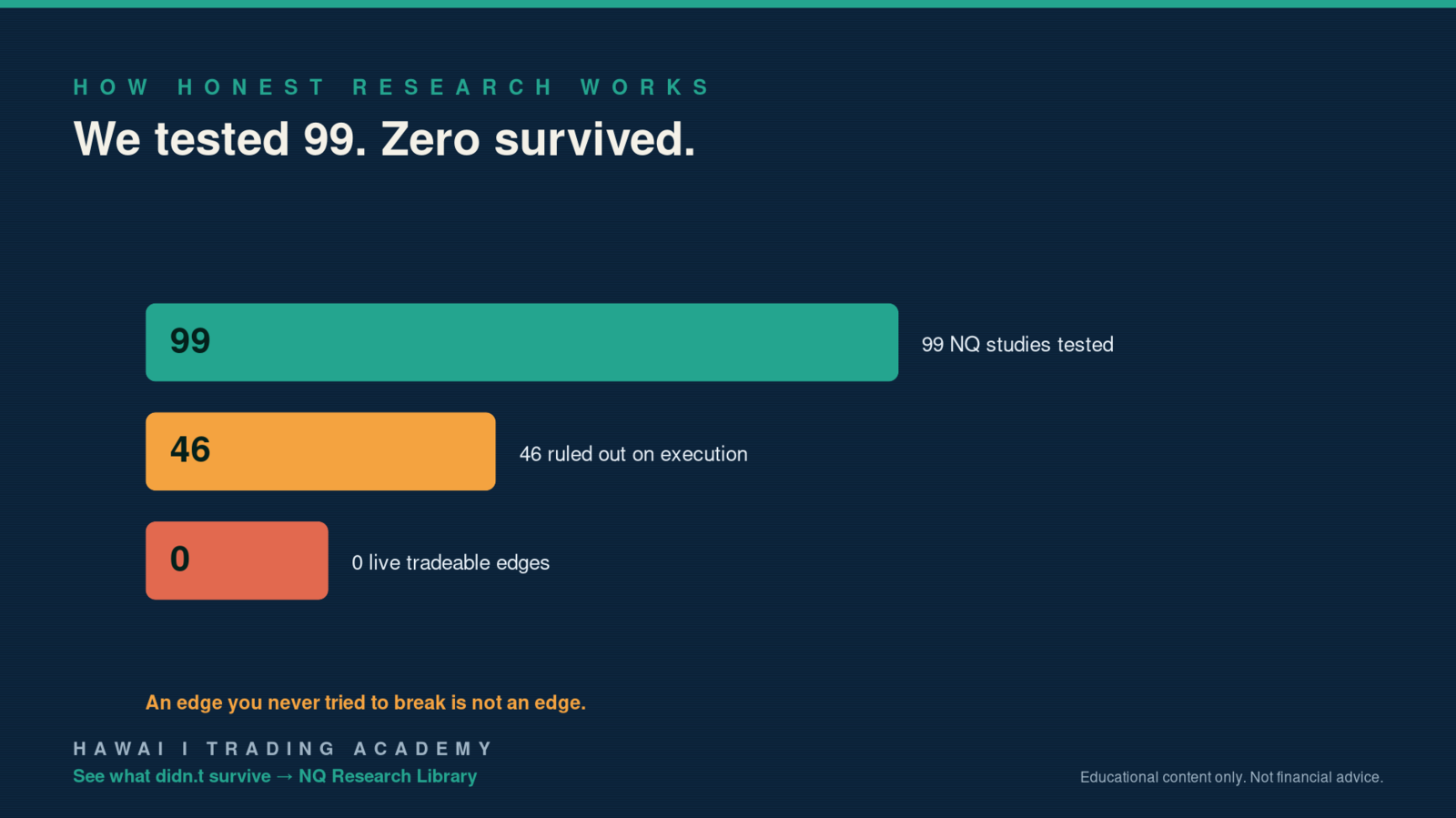
We ran 99 separate studies on NQ futures. Big samples too. One pulled from 2.07 million overnight minutes. Another from 3,883 regular-hours sessions. Then we audited every one for a live, tradeable edge.
The number that survived? Zero. Not one.
Sounds like a bad week. It’s the opposite. This is what honest research looks like. It’s also why we don’t sound like every other trading channel. We’re coaches who trade, not salespeople who teach. The new NQ Research Library inside Net Alpha Pro is 99 receipts to prove it.
Why Publish Research That Found No Edge?
Most trading content shows you the winners and buries the graveyard. We built the library the other way. Every study lists its question, its sample size, its result, and its caveat. Then a September 1 audit sorted all 99 into plain buckets. 46 closed as null or ruled out on execution. 25 were useful only as risk-and-range context. The rest were descriptive structure or forward watchlist leads.
Read that again. Forty-six popular...
How to Vet a Futures Prop Firm Before You Fund It
Two more prop firms shut their doors this spring. Nobody blinked.
That’s the strange part of what’s happening in the funded-trader world right now. The industry crossed 2 million funded traders and roughly $850 million in size, growing about 45% year over year, and at the same time it’s quietly shedding companies. Somewhere between 80 and 100 firms have disappeared since 2024. Growth and die-off at once.
We coach a lot of traders through this decision at Hawai’i Trading Academy, and the question we hear most is the wrong one: “Which firm has the cheapest challenge?” The right question is: “Which firm will still be here when I ask for a payout?”
Why are prop firms disappearing if the industry is booming?
Call it the Great Migration. Traders are moving away from loosely-regulated forex-style shops toward regulated futures prop firms, the TopSteps, Apex, and MyFundedFutures of the world, because futures clear through a real exchange and the rules are clearer.
That migration is brutal...
Fed Day Whipsaws: Why Chasing the First Move Burns Accounts
Friday handed traders another live lesson. Fed Chair Kevin Warsh stepped up for his first Jackson Hole keynote, and the wires lit up. He said this summer's PCE and CPI readings were better than expected, but they do not tell him underlying inflation has meaningfully improved. Translation for the tape: the door to a rate hike next month cracked open. Chips gave back most of Thursday's Nvidia pop, and the Nasdaq closed lower.
If you traded the first headline print, you probably got faked out. That was not bad luck. That is what a Fed day does.
Why does NQ whipsaw so hard around Fed speakers?
An event like a Warsh speech or an FOMC decision dumps a burst of information into the market in seconds. Algorithms react first, they react fast, and they often react in both directions before the tape settles. You get a violent push one way, a snap back, then sometimes a third move that finally sticks.
That first move is the least reliable bar of the day. It is a knee-jerk, not a decision. NQ i...
Recovery Mindset: How to Trade After a Blown Account
Recovery Mindset: How to Trade After a Blown Account
You blew your account. Or you took a drawdown that felt like blowing your account. Either way, you're sitting here wondering if you should quit.
Don't quit yet. But don't just reload and start trading the same way either. That's how you blow the next account too.
Recovery isn't about getting the money back. It's about rebuilding the process that prevents the next blowup. Here's how.
Step 1: Stop Trading for 7 Days
Seriously. Seven full days. No charts. No paper trading. No "just watching." Your brain needs a hard reset. The neural patterns that led to the blowup are still firing. If you trade tomorrow, you'll trade the same way you did yesterday.
During these seven days, journal. Write down what happened. Not the trades — the decisions. What were you thinking? What were you feeling? Where did you deviate from your plan? When did you know it was going wrong and keep going anyway?
Step 2: Audit Your System
After seven days, ope...
Trading Psychology: The One Lesson Behind a Month of Building With AI
Everyone wants one clean result. One backtest that prints green top to bottom. One test suite that passes on the first run. One confident answer from an AI assistant that settles the question so you can stop worrying about it.
We think that want is exactly backwards.
A single good result is never proof. It's a starting point. And if you stop there, you're not managing risk. You're hoping.
Why Do Traders (and Builders) Trust One Good Number?
Because one clean number feels like relief. The backtest worked, so you move on. The code shipped, so you stop testing it. Claude gave you a confident-sounding answer, so you stop asking questions.
This month we walked you through real lessons from building HTA's tools and testing our own strategies alongside Claude. Our Edge & Strategy posts told you straight. We tested 47 strategies. Zero survived full verification.
Every single one looked good at some point. A clean equity curve. A promising win rate. One number that made us want to believe...
Passing Tests ≠ A Working Tool: Our AI Trading Tool Audit Checklist
"If the tests pass, the tool works." That's the assumption almost everyone makes about AI-built software. We made it too. For about twenty minutes.
Earlier this year we had Claude build us a position-sizing guardrail tool. Something to catch us before we sized a trade too big. The first version came back looking sharp. Every test passed. The documentation read like a senior engineer wrote it on a good day. Our gut said ship it.
We didn't. And that decision is the whole point of this post.
What Was A "Perfect" Build Actually Hiding?
I (Reid) run point on our AI builds, so I was the one staring at that first version, ready to call it done. Then we did what we tell every student to do with a new strategy before it touches real money. We audited it instead of trusting it.
What we found wasn't a small bug. It was three of them, stacked underneath a shiny surface.
The tool was reading from a dead data file. A source that no longer existed in the pipeline it was supposedly checking. Run...
Building an AI Trading Risk Tool With Claude: The One Rule We Set Before Writing Any Code
Our position-sizing tool sat quiet for 30 trades before we let it touch anything. It watched real trades come in. It logged what it would have told us to do. It changed nothing.
That wasn’t caution for caution’s sake. That was the plan from day one.
This is post one in a ten-part series on what we’ve actually learned building tools and testing strategies with Claude, Anthropic’s AI. Glenn and I aren’t AI developers by trade. We’re traders who started using Claude to build things we needed and couldn’t buy off the shelf. Some of what we built worked. Some of it didn’t, until we fixed how we were building it. This series is the honest version of that process. What to do, what not to do, no polish added.
Today’s post covers the do’s. Specifically, the three things that kept an AI-built risk tool from ever putting our account in danger, even while it was still rough around the edges.
What’s the One Rule That Comes Before Any Code?
I (Reid) handle most of the AI and content systems at ...