How to Vet a Futures Prop Firm Before You Fund It
Two more prop firms shut their doors this spring. Nobody blinked.
That’s the strange part of what’s happening in the funded-trader world right now. The industry crossed 2 million funded traders and roughly $850 million in size, growing about 45% year over year, and at the same time it’s quietly shedding companies. Somewhere between 80 and 100 firms have disappeared since 2024. Growth and die-off at once.
We coach a lot of traders through this decision at Hawai’i Trading Academy, and the question we hear most is the wrong one: “Which firm has the cheapest challenge?” The right question is: “Which firm will still be here when I ask for a payout?”
Why are prop firms disappearing if the industry is booming?
Call it the Great Migration. Traders are moving away from loosely-regulated forex-style shops toward regulated futures prop firms, the TopSteps, Apex, and MyFundedFutures of the world, because futures clear through a real exchange and the rules are clearer.
That migration is brutal...
The Weekend Review Ritual That Keeps Traders Funded
Let’s be honest, you’re probably overtrading.
Not because you’re undisciplined. Because you’re bored. The market goes quiet, the setup you wanted never shows up, and that itch to do something takes over. So you take the trade that isn’t there. That’s the whole mechanism, and it’s the single most common way we watch good traders bleed out.
The 2026 psychology research says the same thing we see in coaching: overtrading, driven by boredom, action-addiction, and the false math that more trades equals more profit, is the top failure mode for retail traders. And the cleanest antidote isn’t a new indicator. It’s a habit you run on the weekend, when the market is closed and can’t tempt you.
What do the best traders actually do on Saturday?
Not stare at charts. That surprises people.
The weekend isn’t for trading, it’s for reviewing the week you already traded. In our community the ritual has three parts, and none of them are exciting. That’s the point.
Step one: review the tape you alre...
Fed Day Whipsaws: Why Chasing the First Move Burns Accounts
Friday handed traders another live lesson. Fed Chair Kevin Warsh stepped up for his first Jackson Hole keynote, and the wires lit up. He said this summer's PCE and CPI readings were better than expected, but they do not tell him underlying inflation has meaningfully improved. Translation for the tape: the door to a rate hike next month cracked open. Chips gave back most of Thursday's Nvidia pop, and the Nasdaq closed lower.
If you traded the first headline print, you probably got faked out. That was not bad luck. That is what a Fed day does.
Why does NQ whipsaw so hard around Fed speakers?
An event like a Warsh speech or an FOMC decision dumps a burst of information into the market in seconds. Algorithms react first, they react fast, and they often react in both directions before the tape settles. You get a violent push one way, a snap back, then sometimes a third move that finally sticks.
That first move is the least reliable bar of the day. It is a knee-jerk, not a decision. NQ i...
Recovery Mindset: How to Trade After a Blown Account
Recovery Mindset: How to Trade After a Blown Account
You blew your account. Or you took a drawdown that felt like blowing your account. Either way, you're sitting here wondering if you should quit.
Don't quit yet. But don't just reload and start trading the same way either. That's how you blow the next account too.
Recovery isn't about getting the money back. It's about rebuilding the process that prevents the next blowup. Here's how.
Step 1: Stop Trading for 7 Days
Seriously. Seven full days. No charts. No paper trading. No "just watching." Your brain needs a hard reset. The neural patterns that led to the blowup are still firing. If you trade tomorrow, you'll trade the same way you did yesterday.
During these seven days, journal. Write down what happened. Not the trades — the decisions. What were you thinking? What were you feeling? Where did you deviate from your plan? When did you know it was going wrong and keep going anyway?
Step 2: Audit Your System
After seven days, ope...
Trading Psychology: The One Lesson Behind a Month of Building With AI
Everyone wants one clean result. One backtest that prints green top to bottom. One test suite that passes on the first run. One confident answer from an AI assistant that settles the question so you can stop worrying about it.
We think that want is exactly backwards.
A single good result is never proof. It's a starting point. And if you stop there, you're not managing risk. You're hoping.
Why Do Traders (and Builders) Trust One Good Number?
Because one clean number feels like relief. The backtest worked, so you move on. The code shipped, so you stop testing it. Claude gave you a confident-sounding answer, so you stop asking questions.
This month we walked you through real lessons from building HTA's tools and testing our own strategies alongside Claude. Our Edge & Strategy posts told you straight. We tested 47 strategies. Zero survived full verification.
Every single one looked good at some point. A clean equity curve. A promising win rate. One number that made us want to believe...
How to Stop Revenge Trading Futures (Before It Drains Your Account)
You know the feeling. A clean setup goes against you. The stop hits. And instead of walking away, you size up and fire another trade before the candle even closes.
That is revenge trading. And if you trade futures, it can gut your account in a single session.
The standard advice is "just be more disciplined." But discipline is not the fix. A system is. Here is why, and how to build one that keeps you from spiraling.
Why "Just Be Disciplined" Does Not Work
After a loss, your brain shifts into threat mode. The prefrontal cortex - the part responsible for rational decision-making - goes offline. Your amygdala takes over, and suddenly any setup looks valid because your brain is not analyzing the chart. It is trying to fix the pain.
Asking yourself to be disciplined during that moment is like asking someone mid-argument to calm down. The tool you need is the one your brain just shut off.
That is why willpower-based solutions fail. The version of you that made the trading plan this mor...
The Comparison Trap: Why Social Media Destroys Traders
The Comparison Trap: Why Social Media Destroys Traders
Someone just posted a $15,000 profit screenshot on Twitter. Your account made $200 today. You feel like a failure. You're not. You're falling into the comparison trap.
Social media is a curated highlight reel. Nobody posts their losing days. Nobody posts their blown accounts. Nobody posts the 18 months of grinding it took before they got consistent. You're comparing your behind-the-scenes to someone else's highlight reel.
The Psychology of Comparison
Comparison triggers a specific neurological response: relative deprivation. Your brain doesn't evaluate your P&L in absolute terms. It evaluates it relative to what you see around you. If everyone around you is posting $10K days and you made $200, your brain registers that as failure — even though $200 profit on a $25K account is 0.8%, which annualizes to over 200%.
This relative deprivation drives terrible behavior. You oversize because your normal size "isn't enough." You take s...
Passing Tests ≠ A Working Tool: Our AI Trading Tool Audit Checklist
"If the tests pass, the tool works." That's the assumption almost everyone makes about AI-built software. We made it too. For about twenty minutes.
Earlier this year we had Claude build us a position-sizing guardrail tool. Something to catch us before we sized a trade too big. The first version came back looking sharp. Every test passed. The documentation read like a senior engineer wrote it on a good day. Our gut said ship it.
We didn't. And that decision is the whole point of this post.
What Was A "Perfect" Build Actually Hiding?
I (Reid) run point on our AI builds, so I was the one staring at that first version, ready to call it done. Then we did what we tell every student to do with a new strategy before it touches real money. We audited it instead of trusting it.
What we found wasn't a small bug. It was three of them, stacked underneath a shiny surface.
The tool was reading from a dead data file. A source that no longer existed in the pipeline it was supposedly checking. Run...
Building an AI Trading Risk Tool With Claude: The One Rule We Set Before Writing Any Code
Our position-sizing tool sat quiet for 30 trades before we let it touch anything. It watched real trades come in. It logged what it would have told us to do. It changed nothing.
That wasn’t caution for caution’s sake. That was the plan from day one.
This is post one in a ten-part series on what we’ve actually learned building tools and testing strategies with Claude, Anthropic’s AI. Glenn and I aren’t AI developers by trade. We’re traders who started using Claude to build things we needed and couldn’t buy off the shelf. Some of what we built worked. Some of it didn’t, until we fixed how we were building it. This series is the honest version of that process. What to do, what not to do, no polish added.
Today’s post covers the do’s. Specifically, the three things that kept an AI-built risk tool from ever putting our account in danger, even while it was still rough around the edges.
What’s the One Rule That Comes Before Any Code?
I (Reid) handle most of the AI and content systems at ...
NQ Futures Research: Stop Guessing and Ask the Data
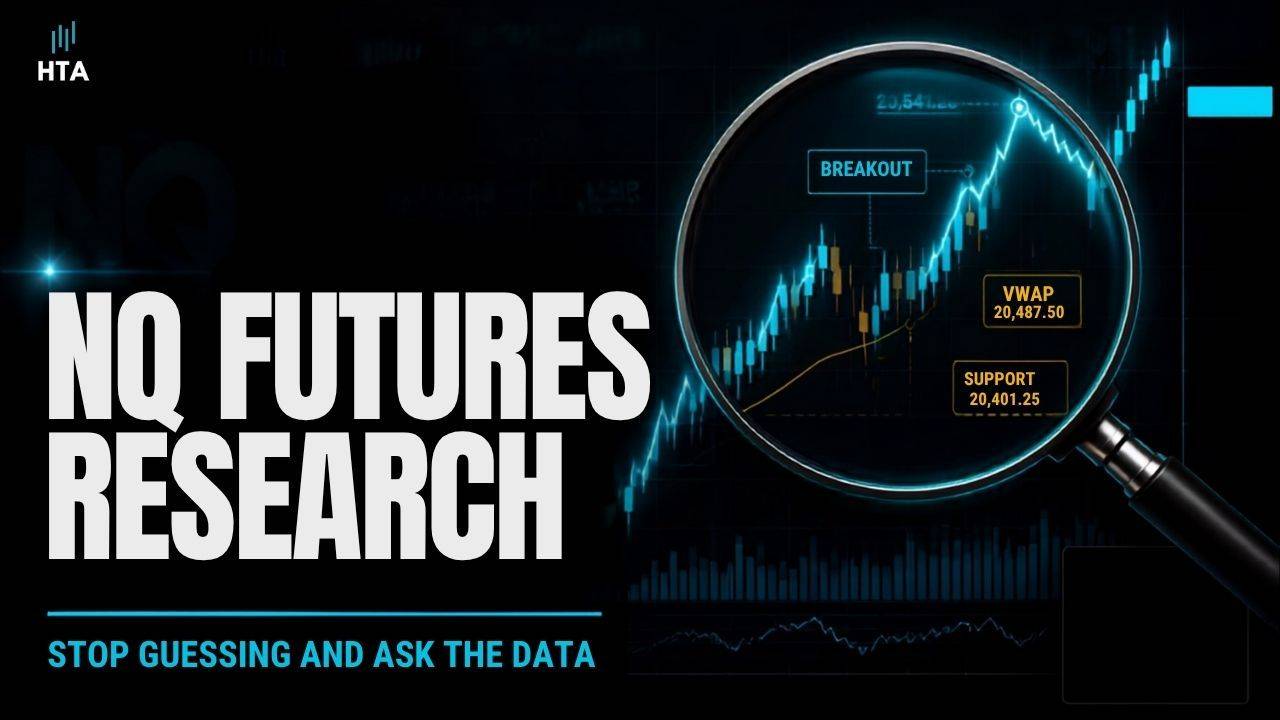
Most trading content answers the wrong question. It tells you what should happen next. Good NQ futures research starts somewhere else: what actually happened the last time this condition showed up, how often did it happen, and how wide was the range of outcomes?
That difference sounds small, but it changes the way you prepare. A chart opinion gives you a story. Research gives you a distribution, a sample size, a definition, and a reason to know when the story is too weak to trust.
Why HTA Is Building an NQ Futures Research Lab
At Hawai'i Trading Academy, our core pillars have always been Risk Management, Edge & Strategy, and Psychology & Process. Research sits right in the middle of all three. It helps you test whether an edge is real, keeps risk expectations grounded, and gives your brain something better than recency bias to lean on when the market gets loud.
We already teach traders to backtest before they trust a setup. In our guide on using TradeZella for backtesting, the poin...