Using AI in Trading: Why Claude Adds Speed, Not Judgment
Everyone assumes AI takes the guesswork out of trading research. It doesn't. It just moves the guesswork somewhere you're less likely to check it.
That's not a knock on Claude. We use it constantly. For research, for building tools, for testing strategies faster than we ever could by hand.
But every time we've gotten burned using AI in this business, it's because we forgot one thing. Claude is a fast assistant, not an oracle.
It will write code, crunch numbers, and explain results in seconds. It can also be confidently wrong just as fast.
You are the analyst. Claude is the intern.
Why Does a Confident Answer Feel Like a Correct One?
Here's a real example from our own research. We had Claude calculate Average True Range on our futures data. ATR is a volatility measure we use to size stops and targets.
The number came back roughly four times too big. A normal ~50-point range was showing up as ~200 points.
Claude never flagged it. It just did the math it was asked to do, on the da...
Trading Discipline Lesson: Write the Test Before You Build the Tool
Third time running the same test. Same trade, same broker export, same expected P&L number sitting in a text file since before we wrote a single line of code. I (Reid) had already watched this exact test fail twice. Once because the tool couldn't find its own data file. Once because the output changed every time we ran it. I hit run a third time and didn't move until the number came back.
We were building a position-sizing guardrail tool with Claude. Something to catch us before we oversized a trade or broke our own rules. Round one of review found 14 real problems. A dead data file. Output that wasn't reproducible. A config file referencing settings that didn't actually exist anywhere in the code.
Not small stuff. The kind of stuff that, if it ships, quietly wrecks your risk management the day you need it most.
Fourteen problems is a lot. It's also, it turns out, the least interesting number in this whole story.
Why Does the Same Test Have to Run Every Time?
Here's what actually ...
Trading Psychology: The One Lesson Behind a Month of Building With AI
Everyone wants one clean result. One backtest that prints green top to bottom. One test suite that passes on the first run. One confident answer from an AI assistant that settles the question so you can stop worrying about it.
We think that want is exactly backwards.
A single good result is never proof. It's a starting point. And if you stop there, you're not managing risk. You're hoping.
Why Do Traders (and Builders) Trust One Good Number?
Because one clean number feels like relief. The backtest worked, so you move on. The code shipped, so you stop testing it. Claude gave you a confident-sounding answer, so you stop asking questions.
This month we walked you through real lessons from building HTA's tools and testing our own strategies alongside Claude. Our Edge & Strategy posts told you straight. We tested 47 strategies. Zero survived full verification.
Every single one looked good at some point. A clean equity curve. A promising win rate. One number that made us want to believe...
The 31% Number
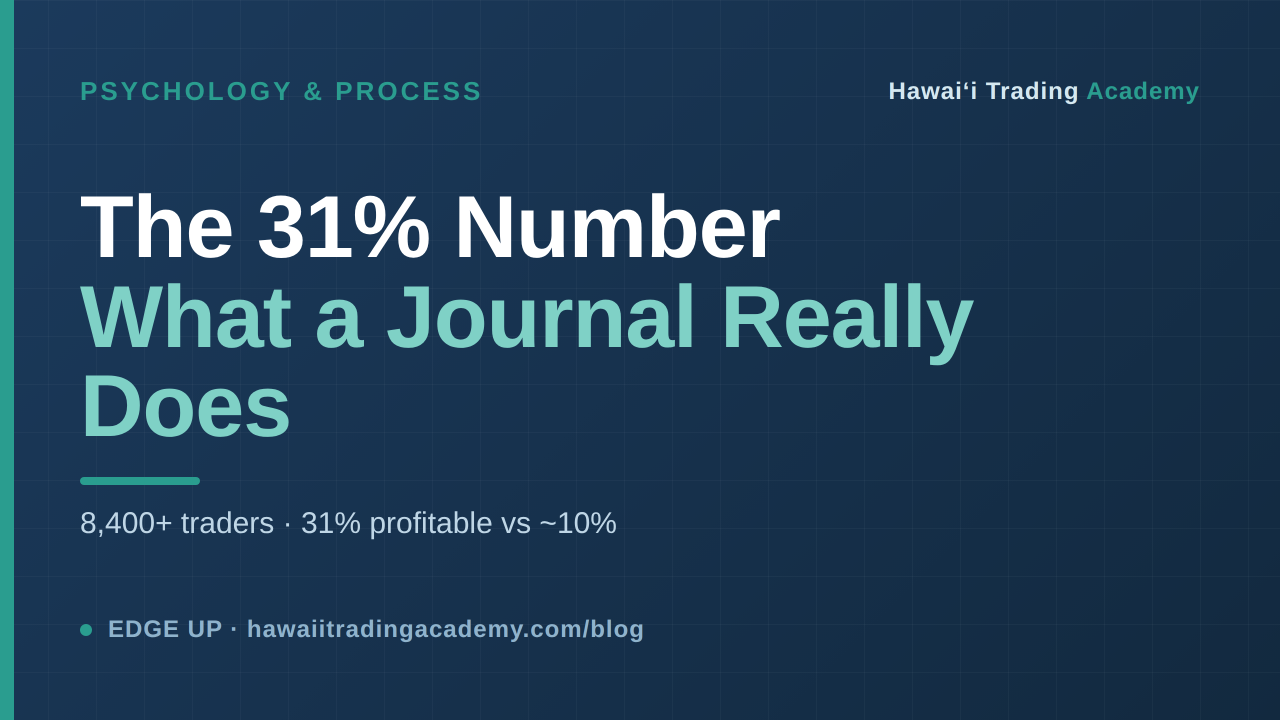
Here's a stat that sounds like a sales pitch: traders who journal for 90+ days are 31% net profitable, versus a roughly 10% baseline for retail. Triple the odds. Just journal.
We're not going to tell you that. Because it's wrong.
The number is real — a 2026 cohort of more than 8,400 active traders who logged 90-plus days of trades came in around 31% net profitable. But the lazy read of that stat — "journaling makes you profitable" — confuses correlation with causation, and if you build your trading on that misread you'll be disappointed and broke.
What the 31% number actually says
Journaling doesn't cause profitability. It self-selects for it.
Think about who logs 90 straight days of trades. Not the impulsive gambler. Not the revenge trader who blows up in week three. The person who journals for three months without missing was already the kind of person who would survive — disciplined, honest with themselves, willing to look at losses instead of hiding them. The journal didn't bu...