How to Trade NFP Futures: Lessons from May 2026's Shock Report
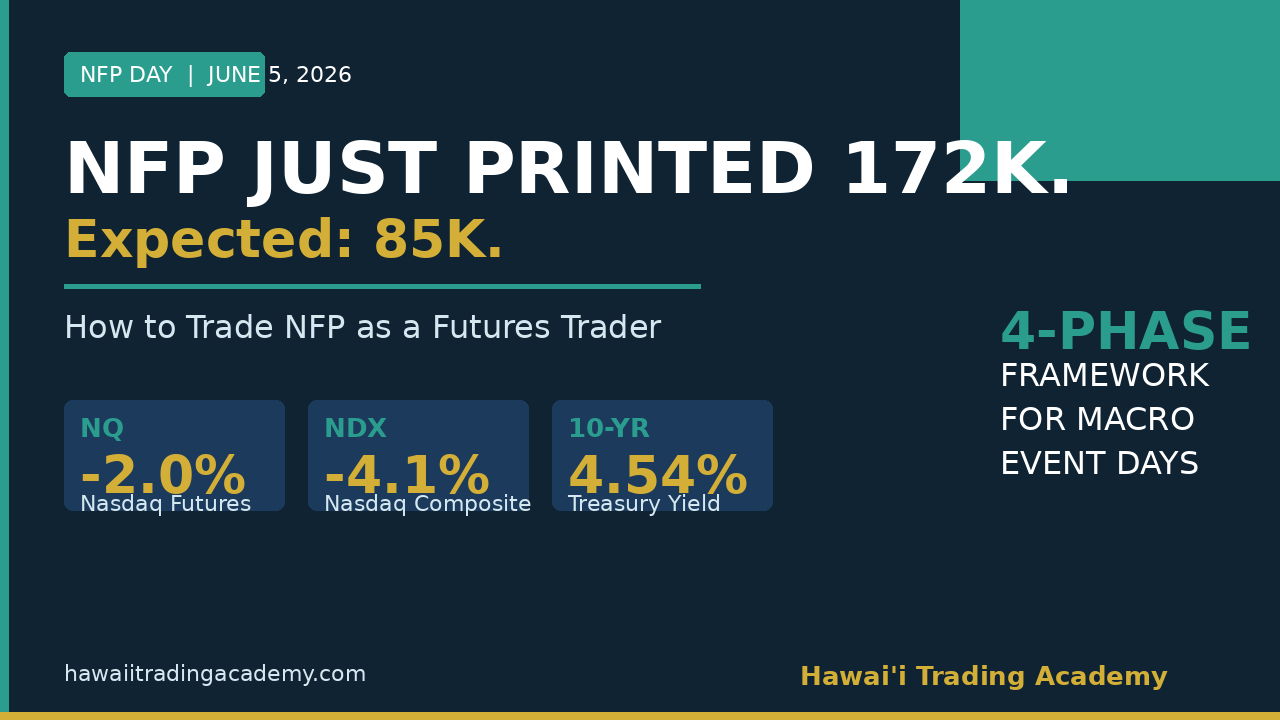
This morning, the May 2026 jobs report printed 172,000 new jobs. The consensus was 85,000.
That's not a miss. That's a near-2x beat on one of the most market-moving data releases of the month.
By the open, the Nasdaq composite was down 4.1%. NQ futures were off nearly 2%. Nvidia dropped 6%. And the 10-year Treasury yield spiked to 4.54% as traders repriced Fed rate hike odds from 50% to 57% overnight.
If you didn't have a plan before 8:30 AM ET today, the market made the decisions for you. This post is about not letting that happen again.
Why Does a Good Jobs Number Tank the Nasdaq?
Before we get into the framework, let's make sure the "why" is clear - because a lot of newer traders are staring at their screens right now confused about why strong employment data would cause a selloff.
Here's the logic: Strong jobs = wage pressure = sticky inflation = Fed keeps rates higher longer = bad for growth stocks = NQ leads the way down.
When 10-year yields jump - they hit 4.54% today - the present value of future tech earnings gets discounted harder. That's why a beat on a labor market report can feel like a gut punch if you're long NQ.
This is what traders call "good news is bad news." And it's one of the most consistent behavioral patterns we've seen in NQ over the past 18 months.
The 4-Phase NFP Trading Framework We Use
We don't trade the NFP number. We trade the reaction - and the reaction has a structure.
Phase 1: Pre-Market Prep (Before 8:30 AM ET)
This is where the edge is built, not traded. Before the number drops:
- Mark your key levels. Today that meant knowing VAH was at 30,054, POC near 29,977, and VAL at 29,922 on NQ. Below that, there was an open gap down to 29,749.
- Write your directional thesis: what would confirm continuation? What would signal a reversal?
- Set your max risk for the day. Non-negotiable before the news hits.
- Decide your no-trade condition. For a lot of our students, if the initial reaction is choppy and unclear, they stay flat.
If you can't answer all four before 8:30 AM, you're not ready to trade NFP.
Phase 2: The First 30 Minutes (8:30–9:00 AM ET)
Don't trade it.
This is our standing rule. The first 30 minutes post-NFP is the highest-noise, lowest-clarity window of the entire trading year. Today was textbook - NQ spiked slightly at open (~30,414), then reversed hard as bond yields jumped and cash equities opened lower.
Reid - who trades the NY session from Hawai'i, up well before sunrise - has a rule: watch the first 30 minutes like film study. Never like a live game. That discipline alone has saved him from some of the worst entries imaginable.
One of our Net Alpha students texted this morning: "I almost went long on the pop at open. I didn't. Glad I waited." That's the discipline. That's the edge.
Phase 3: Post-Noise Setup (9:00–10:00 AM ET)
After the dust settles, real structure emerges. Price finds direction. Levels that held or failed become meaningful.
Today, once cash opened and the "good news is bad news" narrative took hold, NQ found a cleaner direction. The traders who got paid were the ones who waited for confirmation instead of trying to catch the first move.
Look for: price reclaiming or rejecting key levels. Volume confirming the direction. Alignment with the macro story (today: strong NFP = rate hike pressure = NQ bearish).
Phase 4: Continuation or Walk Away
If the setup doesn't meet your criteria after Phase 3, the session ends there. Some of our best trading days are the ones where we trade once, take profit at target, and close the laptop.
NFP Fridays especially. By the afternoon, the market is often thin and choppy as traders square positions ahead of the weekend. The opportunity window on a macro day like this tends to be Phase 3, not all afternoon.
What Today's Numbers Actually Mean Going Forward
Beyond the trading mechanics: the May 2026 NFP report changes the macro backdrop for NQ traders in meaningful ways.
March and April payrolls were revised up by a combined 93,000 jobs. That means the labor market has been consistently stronger than reported. With unemployment holding at 4.3%, the Fed has cover to maintain - or raise - rates. Traders are now pricing a rate hike by year-end at ~57%.
Higher rates for longer = continued headwind for growth and tech = NQ remains in a "prove it" environment, not a "hold and add" one.
For our Strategy Lab traders using mean reversion setups on NQ: this is a regime where directional bias matters more than usual. You can't just fade every dip and expect the same results you got in a low-rate environment. Know your regime. Trade accordingly.
The Psychology Layer Nobody Talks About
Here's the thing we always come back to at Hawai'i Trading Academy: the framework above is simple. The execution is not.
The reason traders blow up on NFP days isn't because they didn't know the levels. It's because the volatility triggers something. A spike that looks like a breakout. A drop that feels like "finally, the trend." The urgency of watching a market move fast.
In our own trade reviews, losing trades cluster around two things: oversized positions and reactive entries. Both spike on macro event days.
Before you trade another NFP: journal your plan the night before. Set your position size. Set your no-trade condition. Then commit to the framework.
The traders in our community who are consistently profitable are not the ones who nailed the NFP call. They're the ones who had a written plan and followed it, regardless of outcome. That's the edge.
Mahalo for reading and trade well!
- Glenn & Reid | Hawai'i Trading Academy
Trading futures involves substantial risk of loss and is not suitable for all investors. Past performance is not indicative of future results.
For education only. Nothing here is financial advice or a recommendation to trade any instrument. Futures trading carries substantial risk of loss and is not suitable for every investor. Past performance does not guarantee future results.