The Prop Firm Evaluation Math: Burn, EV, and the Real Odds
Before you buy another $100K evaluation, run two numbers. Not your win rate. Not your favorite setup. Two numbers decide whether that challenge is a smart bet or a slow leak: how often the account dies before it pays, and what one attempt is worth on average.
At Hawaiʻi Trading Academy, we teach Hawaii trading education the same way we trade. Risk first. A prop firm evaluation is a risk decision, and most traders make it on hope. You see the funded-account dream. You see the small fee. You click buy. The math tells a calmer, more useful story. Let’s run it.
What is “burn” on a prop firm evaluation?
Every evaluation ticket ends one of three ways, and the three always add up to 100%. Path one, it pays. You hit the target, clear the rules, get funded. Path two, it burns. The account gets knocked out before you finish. Path three, it times out. The window closes with no pass and no knockout.
Burn is the one that kills accounts before they pay. Take a common setup. A $100K evaluation with a $3,000 profit target, a $3,000 trailing drawdown, a 10-day minimum, and five winning days. That trailing floor sits $3,000 under your high-water mark, and it gets checked intraday. Touch it once and you are done. One tick. An open position that dips at the wrong moment. It does not matter. No reset. The fee is gone.
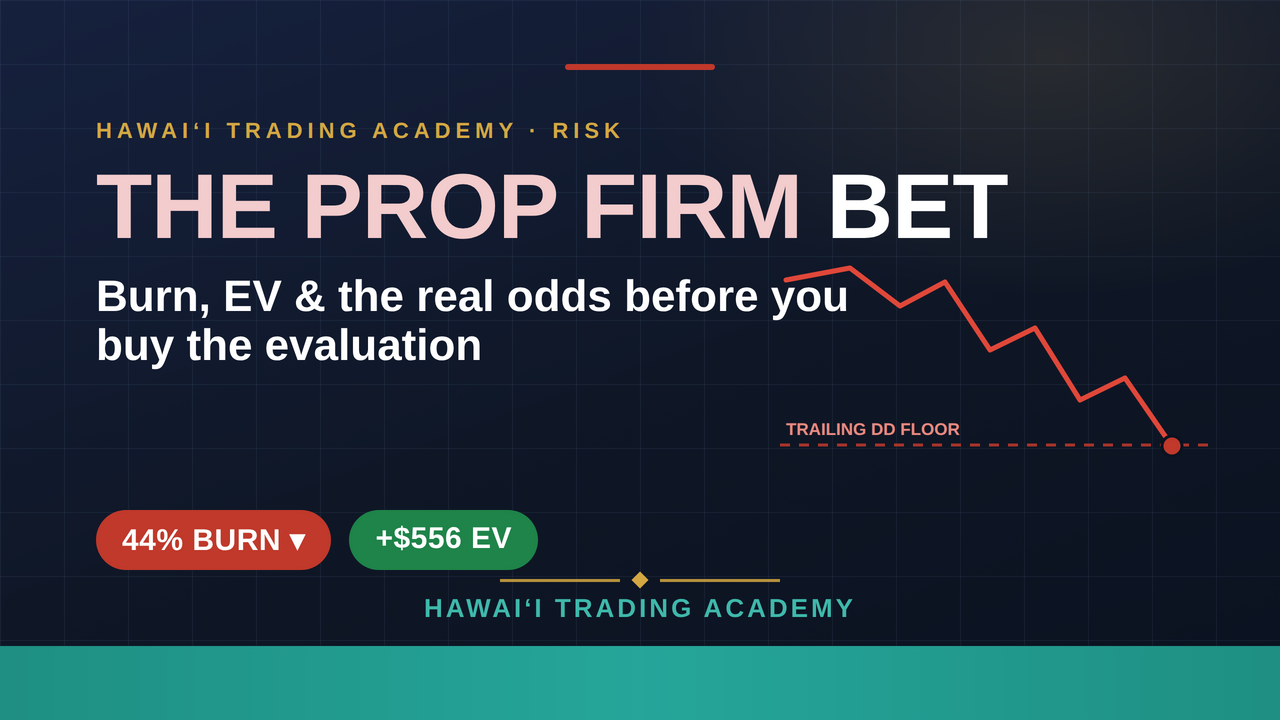
Now the number that matters. Run that setup over a few thousand simulated paths and it splits like this. About 52% of tickets pay. About 44% burn. About 4% time out. Read that again. Almost half the attempts die before they ever see a payout. That is not a broken strategy. That is the shape of the account.
What is a prop firm evaluation actually worth?
Burn tells you how often you lose the fee. Expected value, or EV, tells you what one ticket is worth on average across every outcome. It is the whole bet in one number.
The formula is simple. EV = probability of payout × net payout − fee.
Plug in the setup above, trading two micros. 0.52 × $2,700 − $849 ≈ +$556 per ticket.
Two things to notice. First, that $2,700 is not your whole balance. It is 90% of the $3,000 that transfers to the funded account, because the transfer is capped at the target. Second, and this is where most traders fool themselves, the fee gets paid on every path. Burn and timeout tickets each lose the full $849, and that loss is already baked into the average. That is why a 52% coin with a $2,700 prize nets +$556, not +$1,400. The losers live inside the number. You do not get to look past them.
So the EV is positive. Good. But positive EV is not the same as a good idea. The number is hiding two things.
What the EV number leaves out
First, your hours. Most serious evaluations ban set-and-forget trading, so you have to sit and watch the account. That is real work, and none of it shows up in the $556. Count your time at any fair rate and the picture shifts.
Second, and bigger. The payout has to actually get collected. The EV assumes a legitimately earned payout gets paid in full, on the published terms. That is counterparty risk, and no formula prices it for you. A payout you cannot collect is worth zero, whatever the math says. Before you fund a ticket, do the homework. Payout proof. The fine print. Real withdrawal history.
There is a smaller assumption too. The EV assumes you take the full withdrawal. Leave $1,000 in the funded account to keep a live path open and your first payout shrinks, so the EV drops with it. Change the assumption, run the number again.
So should you buy the evaluation?
A positive EV sitting next to a 44% burn is not a green light. It is a bankroll rule. You only take this bet with money you can lose several times in a row, because that is exactly what the burn rate is warning you about.
Do the arithmetic. Three tickets at $849 is $2,547 of your own capital, for roughly a 60 to 65% chance of landing one payout in a year.
Good with numbers? You might push back. Three independent 52% coins should give about an 89% chance of at least one win. True, if they were independent. They are not. You are the same trader running the same edge on all three. If your edge is thinner than the backtest says, and it usually is, the tickets fail together, not one at a time. That correlation is why the real number lands closer to 60 to 65%. Your worst case is not one unlucky ticket. It is all three at once, because the edge was never really there. (We get into that exact trap, your edge slipping without you seeing it, on the Edge Up Podcast.)
That last part is the psychology, and no calculator captures it. Risk, edge, psychology. Our REPs framework shows up in one checkout decision. The math can say the bet is fine. Your bankroll and your honesty about your own edge decide if it is fine for you.
Run the two numbers before you run the card. Burn tells you how many times you will lose the fee. EV tells you what the bet is worth once you count every loser. Do that, and a funded account stops being a lottery ticket and starts being a business decision.
Amateurs buy the dream. Professionals price the bet.
Mahalo for reading and trade well!
Glenn & Reid, Hawaiʻi Trading Academy