Day Trading Statistics: Why Most Traders Lose Money
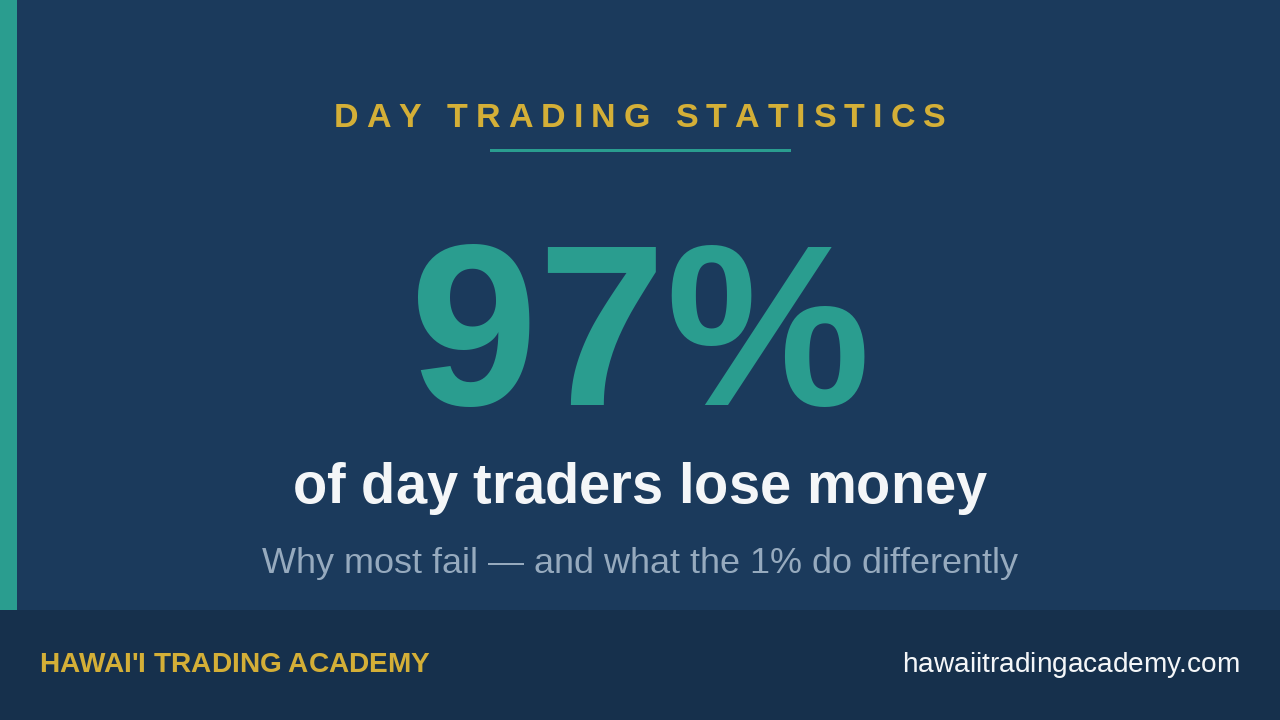
Ninety-seven percent of day traders lose money. You've probably seen that number on an ad right before someone tries to sell you a "secret" strategy. Here's the part they leave out: the stat is real, and it has almost nothing to do with strategy.
We coach traders here in Hawai'i, and we've watched smart, hardworking people light accounts on fire while sitting on a perfectly good edge. So let's actually look at the day trading statistics, figure out what they're really telling us, and talk about what the survivors do differently.
What do the day trading statistics actually say?
The data is remarkably consistent across decades and across countries.
In Brazil, researchers Chague, De-Losso, and Giovannetti tracked every single person who started day trading equity futures between 2013 and 2015. Of the traders who stuck with it for more than 300 days, 97% lost money. Only 1.1% earned more than the Brazilian minimum wage. Not "more than a doctor." More than minimum wage.
In Taiwan, Barber, Lee, Liu, and Odean studied the entire market. Every individual trade. In a typical six-month window, more than 80% of day traders lost money after costs. Fewer than 1% could reliably earn positive returns net of fees.
And the attrition is just as brutal. Industry data suggests roughly 40% of day traders quit within a month, and only about 13% are still trading three years later.
Different continents. Different decades. Same result. When a pattern is that stable, it stops being a market problem and starts being a behavior problem.
So why do most day traders actually lose?
It's not that they can't find a setup. The internet is drowning in setups. You can learn a "strategy" in an afternoon for free.
People lose for three boring reasons: no real risk management, no proven edge, and no control over their own psychology. That's the order we'd rank them, too.
Most traders blow up the account before any edge ever gets a chance to play out. They risk 5-10% on a trade because the setup "looked perfect," hit a completely normal losing streak, and hand back three months of progress in a week. The edge was never the problem. The sizing killed it.
The losers aren't unlucky. They're over-leveraged and under-prepared. That's actually good news, because both of those are fixable.
What does the 1% do differently?
The survivors are boring. We mean that as the highest compliment.
They run fixed risk per trade and they size off the stop. They decide where they're wrong first, then figure out how big the position can be. Not the other way around.
They trade a defined, backtested edge with rules. We lean on setups like our MID-range and back-into-range (BIR) plays, not because they're magic, but because we have the data behind them: positive expectancy over a large sample. If you've never run the numbers on your own edge, start with our breakdown on positive expectancy.
And they win the part nobody wants to hear about: the psychology. Same setup, same checklist, same journal review, every day. They've learned that the words in their head move their hands on the mouse, which is exactly why we wrote about changing the way you talk to yourself as a trader.
They also keep receipts. We journal every trade in TradeZella, backtest in TradingView and run Monte Carlo simulations in TrendSpider, and let the full dataset make decisions, not whatever happened last Tuesday.
How do you get on the right side of the statistics?
You don't need a new strategy. You need a process you'll actually repeat. Here's the short version:
- Define one edge and backtest it. A hundred-plus trades of data before you risk a real dollar.
- Set your risk per trade before you enter. Size off the stop. If the stop's too wide for your account, trade smaller or skip it. Both are professional decisions.
- Journal everything. Your journal doesn't lie. Open it.
- Build the mental game on purpose. Write your invalidation criteria before entry. Set a daily loss cap and honor it.
If you want this in your ears on the drive to the open, we go deep on the survivor mindset on the Edge Up Podcast, including a full episode on what it really takes to pass and keep a prop firm account.
The honest part
We're not going to promise you'll land in the 1%. Nobody honest can, and trading futures involves substantial risk of loss. But here's what the data actually proves: the survivors aren't smarter or luckier than everyone else. They just share a set of habits, and habits can be taught. That's the entire premise behind Hawai'i trading education done right.
Want the system, not just the stats?
That's exactly why we built Net Alpha Pro. It's not a signal group and it's not hype. It's the actual system we trade: three strategy playbooks (Edge, Psychology, Risk), our HTA custom indicator, the Net Alpha strategy library, journaling templates, and monthly group calls where we work through real trades together.
Net Alpha Pro opens May 31, and the first 20 Pro members lock in founding-member pricing at $97/mo. No contracts, cancel anytime, no fake countdown timers. Just the process the surviving minority actually uses. Join Net Alpha Pro here.
Trading futures involves substantial risk of loss and is not suitable for all investors.
Mahalo for reading and trade well!
Glenn & Reid | Hawai'i Trading Academy