How to Vet a Futures Prop Firm Before You Fund It
Two more prop firms shut their doors this spring. Nobody blinked.
That’s the strange part of what’s happening in the funded-trader world right now. The industry crossed 2 million funded traders and roughly $850 million in size, growing about 45% year over year, and at the same time it’s quietly shedding companies. Somewhere between 80 and 100 firms have disappeared since 2024. Growth and die-off at once.
We coach a lot of traders through this decision at Hawai’i Trading Academy, and the question we hear most is the wrong one: “Which firm has the cheapest challenge?” The right question is: “Which firm will still be here when I ask for a payout?”
Why are prop firms disappearing if the industry is booming?
Call it the Great Migration. Traders are moving away from loosely-regulated forex-style shops toward regulated futures prop firms, the TopSteps, Apex, and MyFundedFutures of the world, because futures clear through a real exchange and the rules are clearer.
That migration is brutal...
The Prop Firm Gold Rush Is Over — And That's Good News
Somewhere between 80 and 100 prop firms disappeared in 2024. Not “struggled.” Gone. If you were shopping for a funded account two years ago, a big chunk of the names on your list don’t exist anymore.
That sounds like bad news. We think it’s the opposite.
From roughly 2020 to 2023, the prop-firm world ran on a gold-rush script: cheap challenges, easy funding, big promises, a new firm launching every week. 2026 looks different. The industry now calls it the “operator era” — fewer firms, higher standards, and real weight on trust, risk control, and education. The market quietly repriced hype.
We watched the whole cycle from the coaching side here at Hawai‘i Trading Academy. And the consolidation confirms the thing we built this place around: durable skill beats hype every single time the tide goes out.
What actually happened to all those firms?
Two things, mostly. First, a lot of them were undercapitalized. They sold cheap challenges and paid out on the accounts that passed, quietly ...
Revenge Trading: The 22% Win Rate and the 30-Minute Fix
We told you to wait 10 minutes. The data says that is not long enough.
Earlier this month we published a piece on the drawdown reflex, the biological panic response behind roughly 74% of prop firm breaches. In it we gave you a rule: after any loss, wait 10 minutes before entering a new trade. Let the cortisol drop. Let your prefrontal cortex come back online.
That rule was directionally right. The number was wrong. Here is what the revenge trading data changed about our thinking.
What does the revenge trading data actually show?
Revenge trading has a measurable signature. In journal data it shows up as a specific, identifiable trade: an entry placed within 15 minutes of a loss, at larger than normal size.
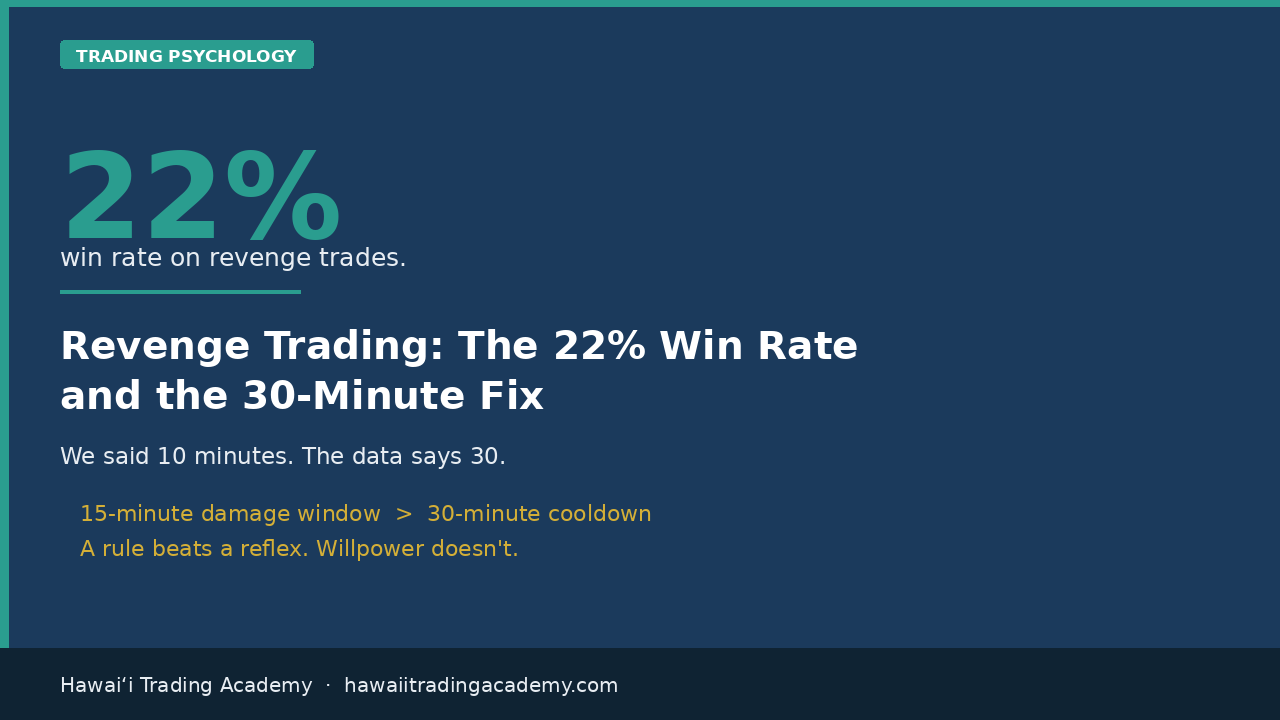
Filter for those two conditions and the numbers are ugly. Those trades won 22% of the time.
Sit with that for a second. Your strategy might win 55%, 60%, 65%. Our RVOL + VWAP mean reversion setup wins 64% across 4,672 backtested trades. The same trader, on the same day, trading ...
Day Trading Statistics: Why Most Traders Lose Money
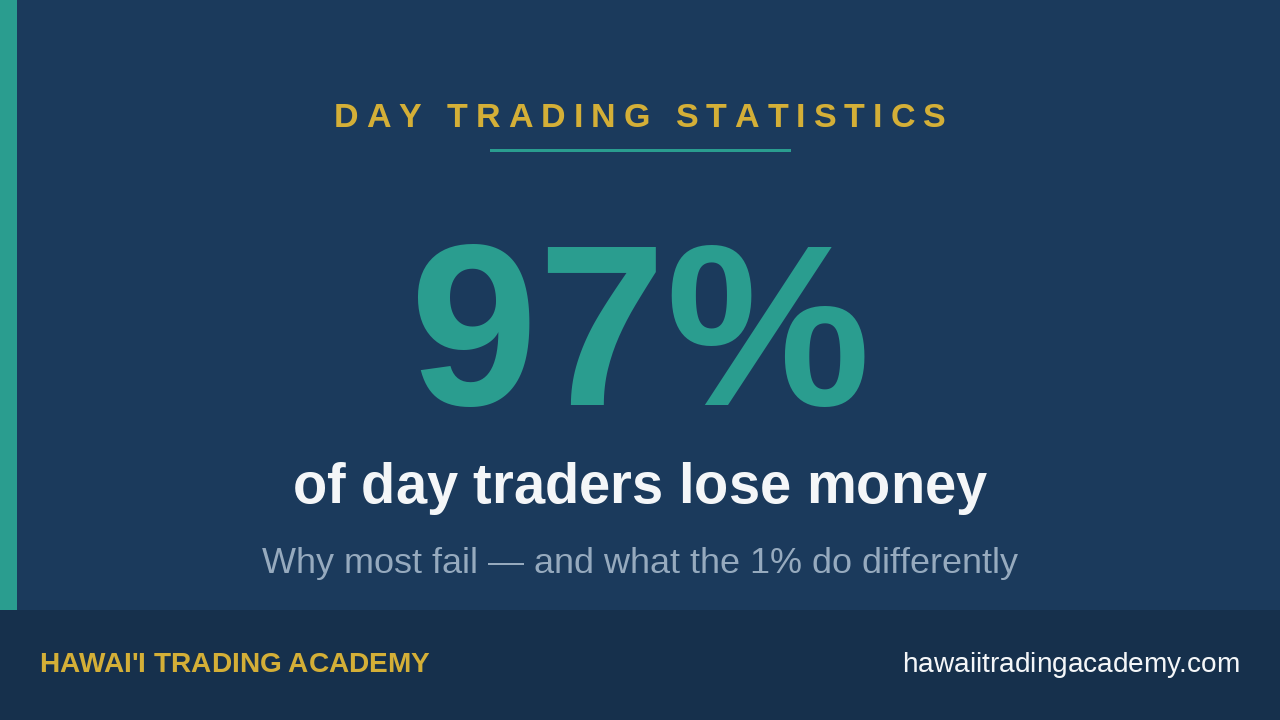
Ninety-seven percent of day traders lose money. You've probably seen that number on an ad right before someone tries to sell you a "secret" strategy. Here's the part they leave out: the stat is real, and it has almost nothing to do with strategy.
We coach traders here in Hawai'i, and we've watched smart, hardworking people light accounts on fire while sitting on a perfectly good edge. So let's actually look at the day trading statistics, figure out what they're really telling us, and talk about what the survivors do differently.
What do the day trading statistics actually say?
The data is remarkably consistent across decades and across countries.
In Brazil, researchers Chague, De-Losso, and Giovannetti tracked every single person who started day trading equity futures between 2013 and 2015. Of the traders who stuck with it for more than 300 days, 97% lost money. Only 1.1% earned more than the Brazilian minimum wage. Not "more than a doctor." More than minimum wage.
In Taiwan, Barb...
Why Gen Z Traders Are Choosing Futures Over Buy-and-Hold
The Numbers Don't Lie
Something shifted in the last five years, and the data makes it impossible to ignore.
87% of Gen Z investors put money into the markets every single month. Compare that to 68% of boomers. Almost half of Gen Z, roughly 47%, trade at least weekly. Gen X? 23%. Boomers? 15%.
14% of Gen Z day trade daily. That's twice the rate of Gen X. Gen Z now represents 40% of new retail forex accounts. And 77% of Gen Z investors started before they turned 25.
Retail futures volume is 50% higher than pre-pandemic levels. CFTC data confirms it: retail participation isn't a spike. It's structural.
This generation isn't sitting on the sidelines waiting for compound interest to do the work. They want to participate. And they're right to feel that way.
Why Passive Feels Broken to a 22-Year-Old
The "buy SPY and wait 30 years" pitch made sense when housing was affordable, wages kept up with inflation, and your parents could retire on a pension.
That world doesn't exist for most yo...
Vibe-Coded Trading Bots Are Losing 77x More Than Human Traders. Here's Why.
A new trend is sweeping through retail trading in 2026. Traders with zero coding experience are asking ChatGPT to write them a trading bot. They describe a strategy in plain English, the AI generates the code, and within hours they're running live capital through untested automation.
They call it "vibe coding." The results call it something else.
UC Berkeley research found that retail bot users lose 77 times more per user than human traders on the same platforms. Not 77% more. 77 times.
What Is Vibe Coding and Why Is It Everywhere?
Vibe coding is exactly what it sounds like: you describe what you want a program to do, and AI writes the code. No programming knowledge required. Business Insider profiled retail traders this month who built entire trading systems using nothing but natural language prompts.
The appeal is obvious. What used to take weeks of development now takes hours. You can go from idea to live bot in an afternoon. The algorithmic trading market hit $18.8 billion in ...
Why Most Traders Lose Money (And What Actually Fixes It)
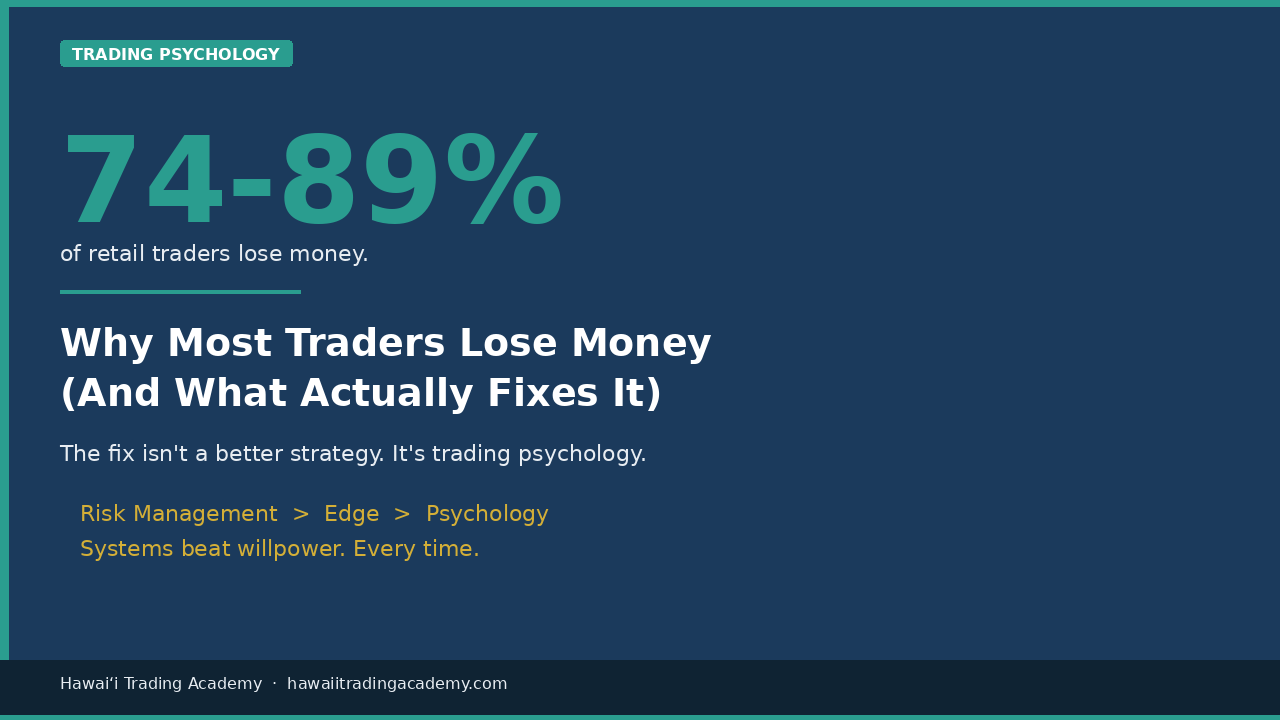
Here's a number that should make you uncomfortable: somewhere between 74% and 89% of retail traders lose money. That range comes from broker disclosures, FINRA reports, and academic studies spanning over a decade. The exact number depends on the asset class and time horizon, but the direction never changes.
Most traders already know this. They've read it in every "top 10 trading tips" article on the internet. And then they do the same thing everyone else does - they go looking for a better strategy.
That's the wrong move.
What Does the Data Actually Say?
A 2019 study out of Brazil tracked 19,646 day traders over two years. 97% of them lost money after 300 days. Not "didn't beat the market" - lost money. The ones who stuck around long enough to be profitable? They made an average of $310 per day. The median was closer to $54.
FINRA data shows 72% of day traders ended their most recent year with financial losses. And more than 75% quit within two years.
Those numbers look like a st...
How to Trade NFP Futures: Lessons from May 2026's Shock Report
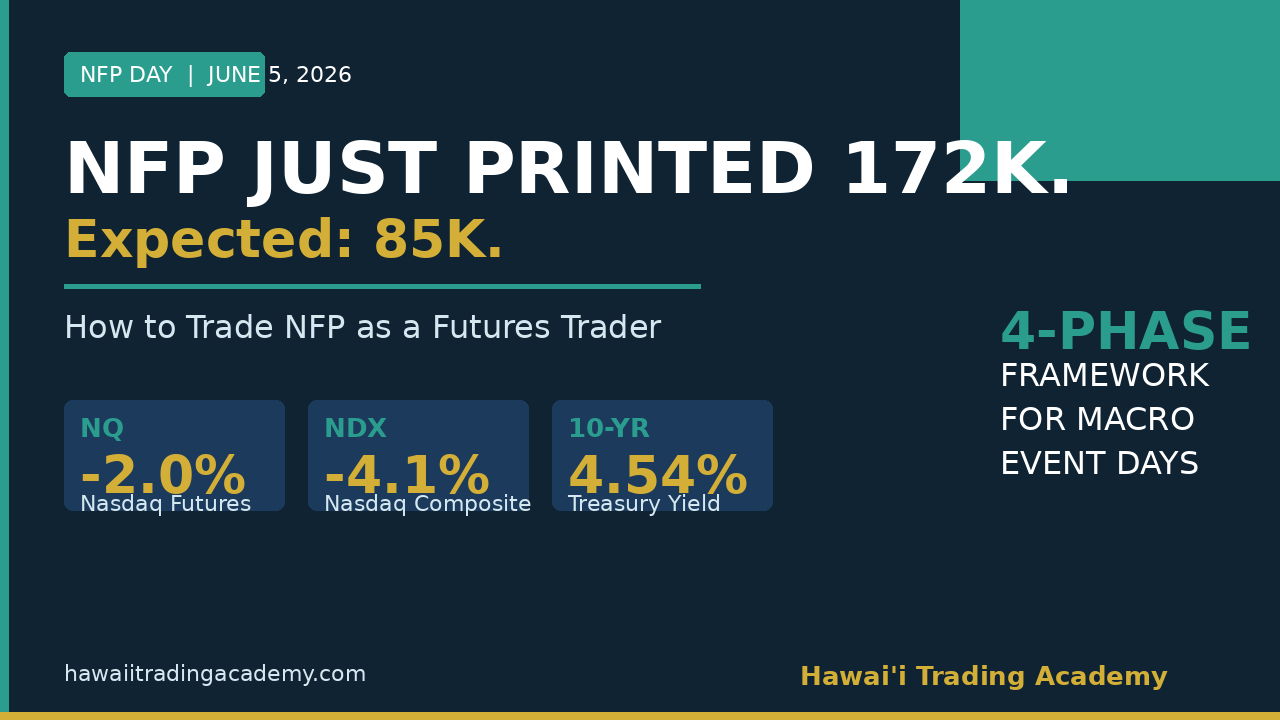
This morning, the May 2026 jobs report printed 172,000 new jobs. The consensus was 85,000.
That's not a miss. That's a near-2x beat on one of the most market-moving data releases of the month.
By the open, the Nasdaq composite was down 4.1%. NQ futures were off nearly 2%. Nvidia dropped 6%. And the 10-year Treasury yield spiked to 4.54% as traders repriced Fed rate hike odds from 50% to 57% overnight.
If you didn't have a plan before 8:30 AM ET today, the market made the decisions for you. This post is about not letting that happen again.
Why Does a Good Jobs Number Tank the Nasdaq?
Before we get into the framework, let's make sure the "why" is clear - because a lot of newer traders are staring at their screens right now confused about why strong employment data would cause a selloff.
Here's the logic: Strong jobs = wage pressure = sticky inflation = Fed keeps rates higher longer = bad for growth stocks = NQ leads the way down.
When 10-year yields jump - they hit 4.54% today - t...
Day Trading Classes in Hawaiʻi: What to Look For (And What to Run From)
You typed "day trading classes near me" into Google at 11 PM, didn't you? Probably after watching a reel of some guy flashing a P&L screenshot from his lambo. We get it. But here's the thing — that search might be the most important financial decision you make this year. Pick the right class and you compress years of painful lessons into months. Pick the wrong one and you're out $5K with nothing but a Discord invite and a lot of regret.
We've been trading futures from Hawaiʻi for over 15 years and coaching traders through Hawaiʻi Trading Academy. We've seen every flavor of trading education — the good, the terrible, and the "why did I give them my credit card" variety. Here's what actually matters when you're evaluating trading classes, whether you're in Honolulu or anywhere else.
Do They Actually Trade?
This is the single biggest filter. Most trading "educators" stopped trading years ago because selling courses is easier than managing risk every morning at 3:30 AM HST. Ask yourself...
POC/VWAP Acceptance Strategy: 2,762 Trades Backtested
We backtested 2,762 trades on a single strategy. 62.7% strike rate. 2.00 R:R. $178,000 in cumulative P&L.
Those numbers aren't a sales pitch. They're a dataset. And the difference between a pitch and a dataset is that a dataset tells you exactly where the strategy doesn't work, too.
Today we're opening the hood on the POC/VWAP Acceptance strategy what it is, why it works, and the conditions that make it fail. Because if you don't know when your edge disappears, you don't really have an edge.
What Is the POC/VWAP Acceptance Strategy?
This is a mean reversion strategy built around two key levels: the Point of Control (POC) from the previous session's volume profile, and the anchored VWAP. When price returns to and "accepts" these levels — meaning it trades there with volume confirmation rather than just spiking through — it creates a high-probability setup.
The logic is straightforward: the POC represents where the most volume traded, which is the market's consensus on fair value. V...