The Identity Shift: From Gambler to Professional Trader
The Identity Shift: From Gambler to Professional Trader
Most traders stay broke because of how they think about themselves, not because of how they trade. This is the identity problem. And until you fix it, no strategy will save you.
A gambler sits down at the table hoping to win. A professional sits down expecting to execute. Same table. Completely different outcomes over time.
Identity Marker #1: Process Over Outcome
Gamblers measure themselves by P&L. "I made $2,000 today" = good. "I lost $500" = bad. This seems logical but it's toxic. It trains you to chase outcomes instead of building process.
Professionals measure themselves by execution quality. "I followed my system on all three trades" = good, regardless of P&L. "I deviated from my rules on a winning trade" = bad, even though you made money. The outcome of a single trade is noise. The quality of your execution is signal.
Identity Marker #2: Small Bets, Long Horizons
Gamblers want the big score. One trade that changes ev...
Decision Fatigue: Why Your Last Trade of the Day Is Your Worst
Decision Fatigue: Why Your Last Trade of the Day Is Your Worst
Your first trade of the day was clean. Good entry. Proper sizing. Stop where it should be. By trade five, you're oversizing, chasing entries, and moving stops. What happened?
Decision fatigue. It's real. It's measurable. And it's destroying your P&L.
The Science
Roy Baumeister's research at Florida State showed that willpower and decision-making draw from the same limited pool of mental energy. Every decision you make — what to eat for breakfast, which route to take to work, whether to enter a trade — depletes that pool.
By the afternoon, you've made hundreds of decisions. Your prefrontal cortex — the part of your brain responsible for rational, deliberate thinking — is running on fumes. Your amygdala — the emotional, reactive part — takes over. This is when you make your worst trades.
How It Shows Up in Trading
Decision fatigue in trading looks like: taking trades that don't meet your criteria because you're "bored....
Recovery Mindset: How to Trade After a Blown Account
Recovery Mindset: How to Trade After a Blown Account
You blew your account. Or you took a drawdown that felt like blowing your account. Either way, you're sitting here wondering if you should quit.
Don't quit yet. But don't just reload and start trading the same way either. That's how you blow the next account too.
Recovery isn't about getting the money back. It's about rebuilding the process that prevents the next blowup. Here's how.
Step 1: Stop Trading for 7 Days
Seriously. Seven full days. No charts. No paper trading. No "just watching." Your brain needs a hard reset. The neural patterns that led to the blowup are still firing. If you trade tomorrow, you'll trade the same way you did yesterday.
During these seven days, journal. Write down what happened. Not the trades — the decisions. What were you thinking? What were you feeling? Where did you deviate from your plan? When did you know it was going wrong and keep going anyway?
Step 2: Audit Your System
After seven days, ope...
Max Loss Days: Setting and Enforcing Hard Stops
Max Loss Days: Setting and Enforcing Hard Stops
Every professional trader has a max daily loss. Most retail traders don't. This gap is why one group makes money and the other bleeds it.
A max daily loss is simple: you decide in advance, while your head is clear, what the largest loss you can take in a single day looks like. Then you enforce it. No negotiation. No exceptions.
Setting One That Actually Works
Your max daily loss should be based on your account size and your strategy's expected drawdown profile. A common starting point: 2% of your account. On a $50K account, that's $1,000. On a $100K account, $2,000.
But the 2% figure is a starting point, not gospel. Some strategies with higher win rates and lower average losses can handle 3%. Some volatile strategies need 1% or less. The key: it should be large enough that you can take 2-3 normal losses without hitting it, but small enough that hitting it doesn't put your account in jeopardy.
Why Enforcement Beats Willpower
Setting...
Risk-Off Checklist: 5 Signals to Stop Trading Today
Risk-Off Checklist: 5 Signals to Stop Trading Today
Every trader has a plan for when to start trading. Almost none have a plan for when to stop. That's the problem.
Signal #1: You Hit Your Daily Max Loss
You've lost 2% of your account today. Your brain says: "Just one more trade. I can make it back." That voice is lying. Your max daily loss isn't punishment. It's architecture. Once you've hit it, you're done.
Signal #2: Two or More Revenge Trading Moments
Revenge trading is when you take a trade that doesn't fit your system because you want to make back the loss. Two revenge trades means your rational mind has checked out. The solution is stopping.
Signal #3: You've Slept Less Than 5 Hours
Sleep deprivation is a cognitive steroid for stupid decisions. Your risk tolerance skyrockets. Your impulse control bottoms out. Don't trade tired. Period.
Signal #4: Major News Event You Haven't Prepped For
When you haven't prepared for a major economic event, the odds change. Your edge rel...
Revenge Trading: The 22% Win Rate and the 30-Minute Fix
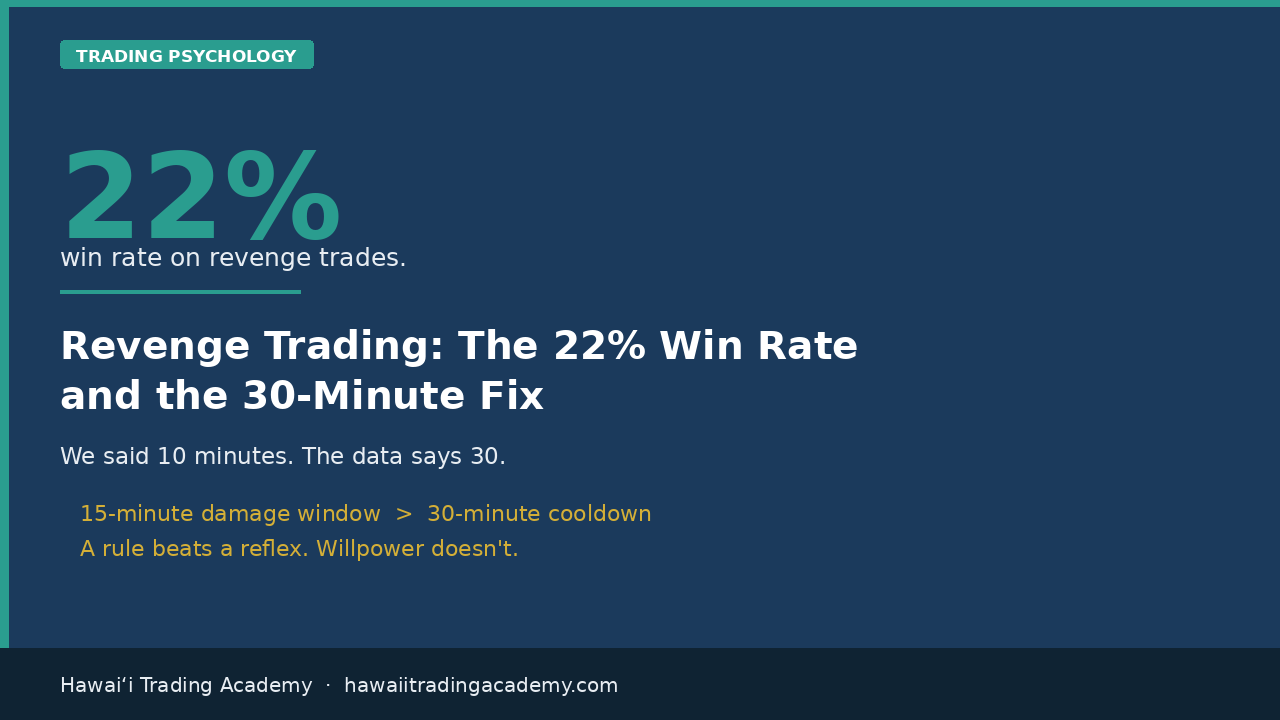
We told you to wait 10 minutes. The data says that is not long enough.
Earlier this month we published a piece on the drawdown reflex, the biological panic response behind roughly 74% of prop firm breaches. In it we gave you a rule: after any loss, wait 10 minutes before entering a new trade. Let the cortisol drop. Let your prefrontal cortex come back online.
That rule was directionally right. The number was wrong. Here is what the revenge trading data changed about our thinking.
What does the revenge trading data actually show?
Revenge trading has a measurable signature. In journal data it shows up as a specific, identifiable trade: an entry placed within 15 minutes of a loss, at larger than normal size.
Filter for those two conditions and the numbers are ugly. Those trades won 22% of the time.
Sit with that for a second. Your strategy might win 55%, 60%, 65%. Our RVOL + VWAP mean reversion setup wins 64% across 4,672 backtested trades. The same trader, on the same day, trading ...
Psychological Operating System: 5 Components
The Psychological Operating System: 5 Components Every Trader Needs
October 2026
You don't need mental toughness. You need architecture. A system that runs when your brain is fried.
Every trader talks about discipline like it's willpower. It's not. Willpower is a depleted resource. You wake up with 100 units of it. By lunch you're down to 30. By day three of a losing streak you're at five. Then you crack. That's not weakness. That's biology.
The traders who last are the ones who stopped relying on willpower. They built systems that run automatically. Five components. Each one executes whether you feel sharp or not. This is your psychological operating system.
Component 1: Pre-Session Protocol
Before you look at a single chart, you run your protocol. Same every trading day. Same checklist. Same journal entry. Same setup. This removes decision fatigue before you even think about a trade.
The specifics don't matter. The consistency does. Your protocol primes your brain for executio...
90-Day Trading Reset: Rebuild From Scratch
90-Day Trading Reset: Rebuild Your Mental Game From Scratch
Sometimes the best thing you can do for your trading is stop trading. Not forever — for 90 days of structured rebuilding.
Our Psychology Playbook includes a 90-Day Reset protocol for traders who are stuck in destructive patterns. It’s not a break. It’s a rebuild.
Phase 1: Audit (Days 1-30)
Stop live trading. Go to sim only. Pull your last 90 days of journal data and diagnose: Where do your losses cluster? What emotional states precede your worst trades? Which rules do you break most often? What time of day is your execution worst?
This phase is uncomfortable because you’re confronting the data. But the data doesn’t lie. One of our students discovered that 73% of his losses came from trades taken after 6:00 AM HST. The fix was obvious — but invisible without the audit.
Phase 2: Rebuild (Days 31-60)
Design your new operating system based on the audit findings. Build specific, self-enforcing rules for each problem the audi...
Trading Journal as Psychology Tool: Track Emotions, Not Just P&L
Your Trading Journal Is a Psychology Tool, Not a Scoreboard
Most traders journal wrong. They log entries, exits, P&L, and maybe a chart screenshot. Then they never look at it again.
That’s not journaling. That’s bookkeeping. And bookkeeping doesn’t make you a better trader.
In our Psychology Playbook, the journal is the most powerful tool in your arsenal — but only if you use it to track emotions and behavior, not just numbers.
The 5 Fields That Actually Matter
Beyond the standard entry/exit/P&L, we require five psychology fields in every journal entry:
1. Emotional state at entry. One word. Calm? Anxious? Bored? Excited? Frustrated? This single data point, tracked over 30+ trades, reveals patterns you can’t see in real time.
2. Emotional state at exit. Did it change? If you entered calm and exited panicked, that tells you something about how you handle drawdowns.
3. Setup quality rating (A/B/C). Was this a textbook setup or a “close enough”? Be honest. Over time, you’ll see th...
The Weekly Reset: How Top Traders Prepare for Monday
The Weekly Reset: How Top Traders Prepare for Monday
Friday close. The week is done. Most traders shut their laptops and don't think about trading until Monday morning. Then they wonder why Monday is their worst day.
The best traders use the weekend differently. They run a Weekly Reset: a structured review that closes one week and prepares for the next. It takes about an hour. It's the highest-ROI hour of your trading week.
Step 1: Trade Review (20 minutes)
Pull up every trade from the week in TradeZella or your journal. Sort by setup type. Calculate win rate, average R, and total P&L by category. Ask: Which setups worked? Which didn't? Were my losses system trades or emotional trades?
Separate the signal from the noise. A bad week with good execution is fine. A good week with bad execution is a warning sign.
Step 2: Rule Adherence Audit (10 minutes)
Go through each trade and mark whether you followed your rules. Calculate your rule adherence percentage. If it's below 80%, that ...