CPI Day Prep: What Every NQ Trader Needs to Know Before May 12
By Glenn & Reid | Hawai'i Trading Academy | May 2026
The April CPI report drops May 12 at 8:30 AM ET. That’s 2:30 AM HST — before most of us are even thinking about charts.
But the move it creates? That’ll define the first two hours of the NQ session. And if you’re not prepared, it’ll define your P&L too — in a direction you don’t want.
Here’s what CPI actually measures, how NQ typically reacts, and what we do (and don’t do) on event days at HTA.
What Is CPI and Why Does NQ Care?
The Consumer Price Index measures the average change in prices paid by consumers for goods and services. The Bureau of Labor Statistics releases it monthly, and it’s the market’s primary gauge of inflation.
Why does NQ move on it? Because inflation drives Fed policy, Fed policy drives interest rates, and interest rates drive the valuation of growth stocks — which make up most of the Nasdaq 100.
Hot CPI (above expectations) = rates stay higher longer = NQ tends to sell off. Cool CPI (below expectations) ...
Your NQ Pre-CPI Playbook: 5 Risk Rules Before the Number Drops
What's your plan when CPI hits at 8:30 AM Eastern on Monday?
If the answer is "I'll figure it out when I see the candle," you're already behind. The traders who survive macro events aren't the ones who predict the number — they're the ones who decided what they'd do before the chaos started.
CPI day is coming May 12th. Here's how we think about it at HTA — and the exact risk framework we teach our students. (Want the full macro framework? Download our free Macro Playbook.)
Why CPI Days Are Different for NQ Traders
Consumer Price Index releases move NQ futures like few other events. We're talking 50-100+ point candles in the first 60 seconds. That's not a normal trading environment — it's a volatility event that changes every assumption your strategy was built on.
Your backtested edge? It was probably validated on normal-session data. Your stop loss? It was sized for average daily range. CPI days aren't average. They're outliers — and outliers break strategies that weren't designed...
The Drawdown Throttle: Auto-Reduce Risk Before Blowup
The Drawdown Throttle: How to Auto-Reduce Risk Before You Blow Up
Every blown account has the same autopsy: the trader kept full size during a drawdown.
They knew they were losing. They felt the tilt building. And instead of throttling down, they pressed harder — trying to make it back in one trade. The math was against them before their finger hit the buy button.
At HTA, we built a system that makes throttling automatic. We call it the Drawdown Throttle, and it’s the single most important risk architecture you can install in your trading.
How Does the Drawdown Throttle Work?
It’s a pre-set system of position size reductions tied to drawdown thresholds. No judgment calls. No “I’ll be careful.” The rules trigger automatically based on where your equity sits.
Here’s a simple version:
Level 1 — Down 2% on the day: Cut position size by 50%. You’re still in the game, but with half the exposure.
Level 2 — Down 3% on the day: Stop trading. Pau. Close the platform. You’re done for the ...
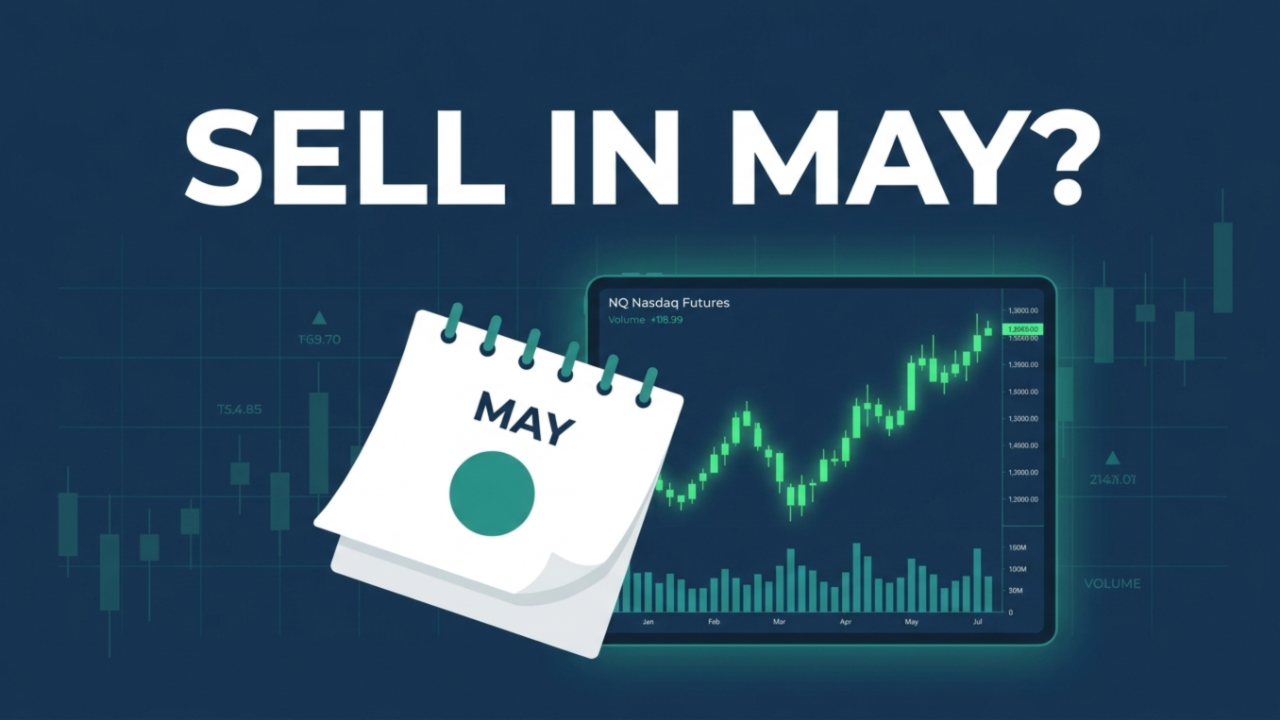
Sell in May? Why Calendar Trading Isn't Edge — And What Actually Is
By Glenn & Reid | Hawai’i Trading Academy
Every year, like clockwork, the trading internet loses its mind over five words: “sell in May and go away.”
Financial media runs the same recycled segments. Twitter threads pile up. And somewhere, a retail trader closes a perfectly good position because a 200-year-old British saying told them to.
Here’s the thing — we’ve looked at the data. And the data says this “rule” is mostly noise.
What Does “Sell in May” Actually Claim?
The idea is simple: stocks underperform between May and October compared to November through April. So you should sell your positions in May, sit in cash for six months, and buy back in November.
Sounds clean. Sounds disciplined. It’s also leaving massive money on the table.
Here’s one stat that should end the debate: a hypothetical $1,000 invested in the S&P 500 in 1976 and held continuously would have grown to roughly $294,795 by end of 2025. That same $1,000 following the sell-in-May strategy? About $46,351. You’...
POC/VWAP Acceptance Strategy: 2,762 Trades Backtested
We backtested 2,762 trades on a single strategy. 62.7% strike rate. 2.00 R:R. $178,000 in cumulative P&L.
Those numbers aren't a sales pitch. They're a dataset. And the difference between a pitch and a dataset is that a dataset tells you exactly where the strategy doesn't work, too.
Today we're opening the hood on the POC/VWAP Acceptance strategy what it is, why it works, and the conditions that make it fail. Because if you don't know when your edge disappears, you don't really have an edge.
What Is the POC/VWAP Acceptance Strategy?
This is a mean reversion strategy built around two key levels: the Point of Control (POC) from the previous session's volume profile, and the anchored VWAP. When price returns to and "accepts" these levels — meaning it trades there with volume confirmation rather than just spiking through — it creates a high-probability setup.
The logic is straightforward: the POC represents where the most volume traded, which is the market's consensus on fair value. V...
The Weekly Reset: How Top Traders Prepare for Monday
The Weekly Reset: How Top Traders Prepare for Monday
Friday close. The week is done. Most traders shut their laptops and don't think about trading until Monday morning. Then they wonder why Monday is their worst day.
The best traders use the weekend differently. They run a Weekly Reset: a structured review that closes one week and prepares for the next. It takes about an hour. It's the highest-ROI hour of your trading week.
Step 1: Trade Review (20 minutes)
Pull up every trade from the week in TradeZella or your journal. Sort by setup type. Calculate win rate, average R, and total P&L by category. Ask: Which setups worked? Which didn't? Were my losses system trades or emotional trades?
Separate the signal from the noise. A bad week with good execution is fine. A good week with bad execution is a warning sign.
Step 2: Rule Adherence Audit (10 minutes)
Go through each trade and mark whether you followed your rules. Calculate your rule adherence percentage. If it's below 80%, that ...
Building a Trading Business Plan: Beyond Just Entries
Building a Trading Business Plan: Beyond Just Entries
Ask a trader about their business plan and they will show you a chart setup. That is not a business plan. That is one entry signal. A real trading business plan covers five areas that most traders never think about.
Section 1: Edge Definition
What is your edge? Not your strategy. Your edge. An edge is a statistical advantage that produces positive expected value over a large sample of trades. Your strategy is how you exploit that edge.
Write it down in one sentence. Example: I trade RVOL + VWAP mean reversion setups on NQ futures during the first two hours of the session, with a 58% win rate and 1.8:1 average reward-to-risk. That is an edge definition. If you can't write one, you don't have an edge yet.
Section 2: Risk Parameters
Your risk parameters are the hard limits that protect your capital. Max risk per trade (1-2% of account). Max daily loss (2-3% of account). Max weekly loss (5% of account). Max monthly drawdown (8-10%...
7 Cognitive Biases Costing You Money in the Markets
You think you're rational when you trade. You're not. Nobody is.
Your brain comes pre-loaded with shortcuts that helped your ancestors survive in the wild. Problem is, those same shortcuts are absolute garbage for financial decision-making. They fire automatically, they feel logical, and they cost you real money.
Here are the seven that hurt traders the most — and what you can actually do about each one.
1. Loss Aversion: Why Losses Hurt 2x More Than Wins Feel Good
Losing $500 feels roughly twice as painful as winning $500 feels good. This isn't philosophy — it's neuroscience. The result? You hold losers too long (hoping they'll come back) and cut winners too short (locking in gains before they evaporate).
The fix: Hard stops. Not mental stops — real orders in the platform. If the stop is placed before you enter, your emotional brain doesn't get a vote on when you exit.
2. Confirmation Bias: Seeing What You Want to See
Once you have a thesis, your brain actively filters informat...
The Discipline Paradox: Why Trying Harder Hurts Trading
Every trading mentor tells you the same thing: "You just need more discipline."
They're wrong.
Not because discipline doesn't matter — it absolutely does. But because the way most traders pursue discipline is backwards. They try to muscle through bad decisions with willpower. They white-knuckle their way through sessions. And when willpower runs out (it always does), they blame themselves for lacking discipline.
The paradox is this: the more you rely on discipline, the less disciplined you become. The solution isn't more effort. It's better architecture.
What Is the Architecture Principle?
At HTA, we teach what we call the Architecture Principle: don't rely on in-the-moment decisions. Build systems that make the right behavior the default behavior.
Think about it like a gym habit. The person who "decides" to go to the gym every morning will eventually skip. The person who lays out their gym clothes the night before, drives past the gym on their commute, and has a training partner...
Positive Expectancy Explained: Does Your Strategy Work?
What if the strategy you've been trading for six months has a negative edge — and you have no idea?
Most traders can't answer one simple question: does your strategy actually make money over time? Not "does it feel profitable." Not "did it work last week." Does the math confirm a statistical advantage?
If you can't answer that with a number, you're not trading. You're gambling with extra steps.
What Is Positive Expectancy?
Positive expectancy means that over a large enough sample of trades, your strategy produces a net profit. Simple concept. Shockingly few traders actually verify it.
The formula is straightforward:
Expectancy = (Win Rate × Avg Win) – (Loss Rate × Avg Loss)
If that number is positive, you have an edge. If it's negative, you're bleeding money no matter how good your risk management is. You can't risk-manage your way out of a losing strategy.
At HTA, we don't let anyone trade a strategy live until they've confirmed positive expectancy across at least 100 trades i...